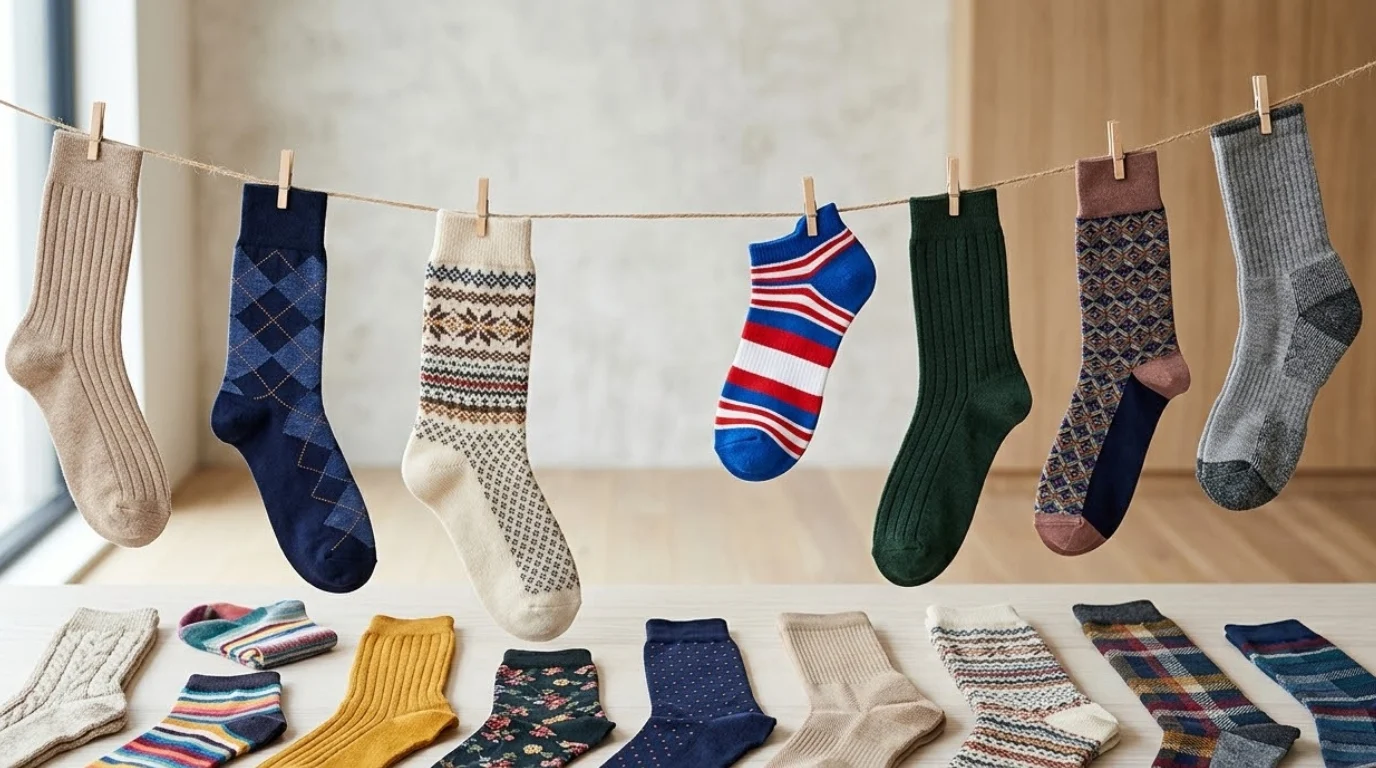
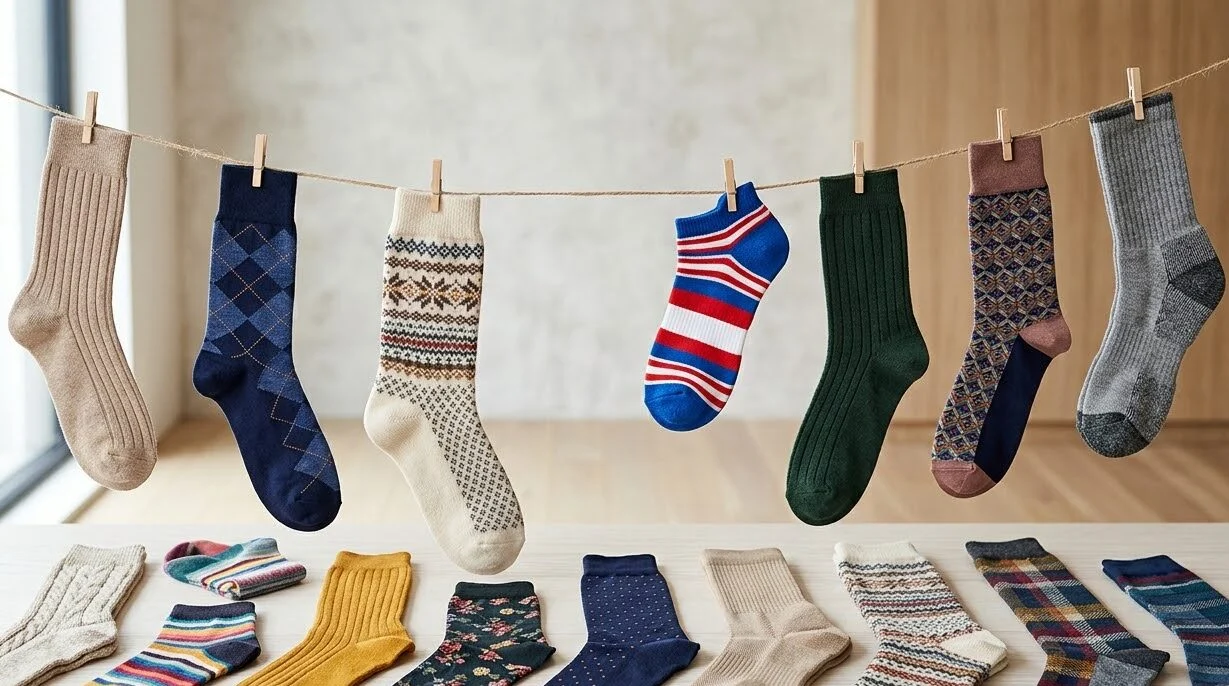
Walk into any sock store, or scroll through any sock website, and the sheer variety can be overwhelming. Ankle socks, crew socks, no-shows, knee-highs, compression socks, dress socks, athletic socks, wool socks, bamboo socks, novelty socks with cats on them. How did something as simple as a foot covering become so complicated? The answer is that different socks solve different problems, and understanding what’s available helps you stop buying the wrong socks and start buying ones that actually make your day better.
At Sokisahtel, we carry over 1,500 different sock models, from everyday cotton basics to Italian-made Pierre Mantoux hosiery, so we’ve spent more than a decade helping people navigate this surprisingly complex world. This guide organizes every type of sock by length, style, material, and purpose, so you can quickly find exactly what you need.
Sock Types by Length
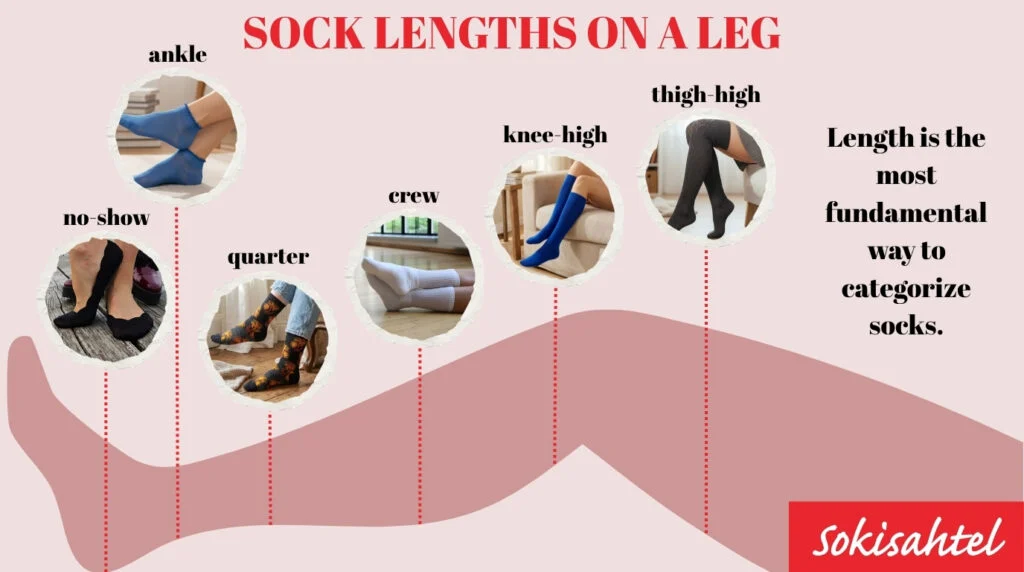
Length is the most fundamental way to categorize socks, and it’s usually the first thing you should decide when shopping. The right length depends on your shoes, the occasion, and the season. Here’s every standard sock length, from shortest to tallest.
No-Show Socks (Invisible Socks / Liner Socks)
No-show socks sit below the shoe line, completely invisible when you’re wearing low-cut shoes. They exist for one reason: to give you the barefoot look while still providing a barrier between your foot and the shoe interior. That barrier matters more than you might think, going truly barefoot in shoes leads to blisters, excessive sweating, odor buildup inside the shoe, and premature deterioration of the shoe lining.
The biggest issue with cheap no-shows is slipping. If you’ve ever spent a day constantly reaching down to pull your sock back onto your heel, you know the frustration. Look for no-shows with silicone grip strips on the heel, this one feature makes the difference between a sock that stays put and one that ends up bunched under your arch by noon. At Sokisahtel, our footies and no-show collection focuses on exactly this: socks that actually stay invisible all day.
Best paired with: Loafers, boat shoes, low-top sneakers, slip-ons, ballet flats, and any outfit where you want the sockless aesthetic, popular in summer with cropped trousers, shorts, or skirts.
Ankle Socks
Ankle socks hit just above the ankle bone, roughly 2-4 cm above the shoe line. They’re the world’s most popular everyday sock length, the default choice you’ll find in multipacks at every clothing store. There’s a reason for their ubiquity: ankle socks are casual, comfortable, unobtrusive, and work with the vast majority of everyday shoes and outfits. They provide enough coverage to prevent shoe rubbing around the ankle while leaving most of your lower leg exposed for a relaxed look.
For athletic use, ankle socks are a solid choice for gym workouts, running, and everyday sports. However, they offer minimal protection above the ankle, so they’re not ideal for hiking boots or any shoe with a tall collar that might rub against bare skin. If you spend your days in sneakers, trainers, or casual shoes, ankle socks will cover 90% of your needs. Browse our women’s sock selection or men’s socks for everyday ankle options.
Quarter Socks
Quarter socks extend about 5-8 cm above the ankle bone, roughly a quarter of the way up your calf. This extra height might sound minor, but it solves a real problem that ankle socks can’t: protection of the Achilles tendon and lower ankle area from shoe rubbing. Quarter socks have become the preferred length for many athletic brands precisely because they prevent the blisters and irritation that form when a shoe collar repeatedly rubs against bare skin during movement.
Quarter socks are often confused with ankle socks when shopping online, so check the stated height carefully. They’re an excellent middle ground, more protective than ankle socks, less visible than crew socks, and they’re steadily growing in popularity for both athletic and casual wear. If you run, play tennis, or do any sport that involves lateral movement, quarter socks are worth trying over standard ankle socks.
Crew Socks
Crew socks reach mid-calf, approximately 15-20 cm above the ankle bone. When someone says “socks” without any further description, this is what most people picture. Crew socks are the most versatile length in existence, they work for casual wear, office settings, sports, hiking, and cold weather. They sit high enough that your bare leg never shows when you sit down and your trouser leg rides up, which makes them the minimum acceptable length for business and formal settings.
Crew socks have also become a deliberate fashion statement in recent years. The “pulled-up crew sock with sneakers” look, once considered a dad faux pas, is now a core element of streetwear and athleisure. White crew socks with chunky sneakers and shorts? That’s a look people are choosing on purpose, and it works. For cold weather, crew socks provide meaningful warmth by covering the lower calf where cold air would otherwise hit bare skin. If you could only own one sock length for the rest of your life, crew would be the rational choice.
Knee-High Socks
Knee-high socks extend from the foot to just below the kneecap, roughly 35-40 cm above the ankle. They serve both practical and fashion purposes. On the practical side, knee-highs provide maximum warmth and coverage, essential for tall boots where you don’t want your sock to end mid-calf and create a visible line or uncomfortable pressure point. On the fashion side, knee-highs paired with skirts and dresses create a distinctive, eye-catching look that ranges from preppy schoolgirl to sophisticated European, depending on the styling.
Knee-highs are also the standard length for football, rugby, and other field sports. In the medical world, knee-high compression stockings are among the most commonly prescribed garments for circulation issues, travel, and post-surgical recovery. Our knee-high collection includes everything from sheer, elegant options to warm wool knee-highs for winter.
Thigh-High and Over-the-Knee Socks
These extend above the knee to mid-thigh or higher, and they’re primarily a fashion item. Thigh-highs make a bold visual statement, they’ve been a recurring trend in autumn/winter collections for years, paired with short skirts, dresses, or worn peeking out from tall boots. Cable-knit thigh-highs in wool or cotton have a cozy, romantic quality; sleek, fitted versions in fine knit lean more dramatic and evening-appropriate.
The practical challenge with thigh-highs is keeping them up. Look for versions with silicone grip bands at the top, or pair them with a garter belt for a secure fit. At Sokisahtel, we carry hold-ups and thigh-highs from Pierre Mantoux and other European brands known for quality construction and elegant design.
Sock Types by Purpose and Style
Athletic Socks
Athletic socks are engineered for performance rather than looks. They typically feature moisture-wicking materials (synthetic blends, merino wool, or bamboo), cushioned soles that absorb impact, arch support bands that keep the sock in place during movement, and reinforced heels and toes for durability in high-friction areas. Good athletic socks also have mesh ventilation panels on the top of the foot for breathability and flat or seamless toe closures that prevent irritation during repetitive motion.
The right athletic sock varies by sport: runners generally prefer ankle or quarter length with lightweight cushioning; hikers need mid-calf or crew length with medium-to-heavy cushioning in merino wool; gym-goers can choose based on preference, though quarter length with arch support is a reliable all-rounder. We stock athletic socks for women and men in a range of materials and weights.
Dress Socks
Dress socks are thin, smooth, and made from fine-gauge materials like combed cotton, merino wool, silk blends, or high-quality viscose. Their purpose is to look sleek and professional inside dress shoes while providing enough coverage that no bare skin shows when you sit down. Mid-calf length is the standard for dress socks, anything shorter risks the embarrassing flash of leg between trouser hem and shoe top.
The traditional rule for dress socks is to match them to your trousers (not your shoes), creating a seamless visual line from pant to foot. Dark navy, charcoal, and black cover most business situations. However, subtly patterned dress socks, small dots, thin stripes, muted checks, have become an accepted way to express personality within professional dress codes. At Sokisahtel, our men’s dress sock selection in sizes 40-42 and 43-45 is made from combed cotton for that fine, elegant finish that suits demand.
Compression Socks
Compression socks apply graduated pressure, tightest at the ankle, decreasing up the calf, to improve blood circulation in your lower legs. They were originally a medical product for patients with circulatory issues, but they’ve been widely adopted by travelers (preventing DVT on long flights), nurses and healthcare workers (reducing leg fatigue during 12-hour shifts), pregnant women (managing swelling), and athletes (speeding post-exercise recovery).
Compression levels range from mild (8-15 mmHg) for everyday comfort to extra firm (30-40 mmHg) for medical conditions. For most everyday users, travelers, office workers, people who stand a lot, moderate compression (15-20 mmHg) is the sweet spot. Our compression collection includes both medical-grade and everyday options.
Novelty and Patterned Socks
Socks have become one of the most accessible ways to express personality through clothing. Novelty socks feature everything from cats and dogs to food, professions, hobbies, holidays, and humorous messages. At Sokisahtel, “message” socks with slogans have become some of our bestsellers, people love wearing a small, hidden piece of personality that they can reveal with a flash of ankle or a crossed leg.
Patterned socks (polka dots, stripes, argyle, geometric designs) occupy the middle ground between novelty and dress, they add visual interest without being as loud as a sock with a pizza slice on it. They make excellent gifts because they’re personal, inexpensive, and universally useful. Our polka dot and message sock collection is a great starting point, and our animal sock collection (cats, dogs, and more) is perpetually popular.
Toe Socks
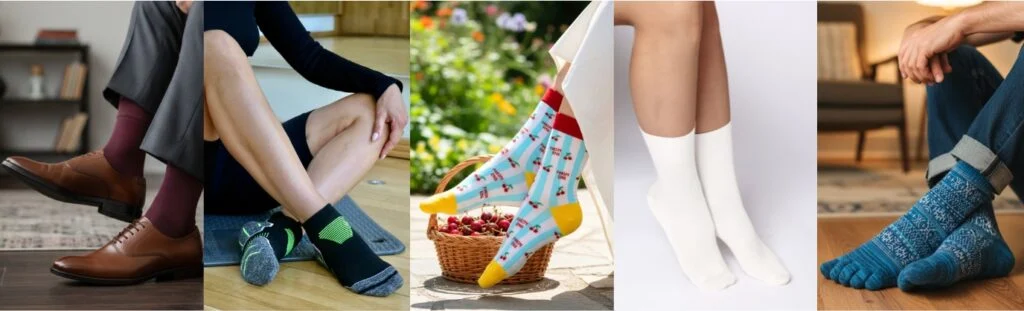
Toe socks have individual compartments for each toe, similar to glove fingers. They look unusual, but they serve a genuine purpose: by separating the toes, they reduce friction between them, prevent blisters in the toe area, and improve balance and toe splay. Runners and hikers who are prone to inter-toe blisters swear by them. They also work well with flip-flops and toe-post sandals. The initial sensation of fabric between your toes takes a few wears to get used to, but most converts find they prefer the feeling once they’ve adjusted. We carry toe socks for those who want to try this distinctly different sock experience.
Sock Types by Material
The material of a sock determines its performance characteristics more than any other factor. Here’s what each material actually does well (and where it falls short).
Cotton
Cotton is the world’s most common sock material. It’s soft, breathable, affordable, and available everywhere. For casual, everyday wear in mild to warm weather, cotton socks do the job. However, cotton has one significant weakness: it absorbs moisture and holds it. This means cotton socks get damp from foot sweat and stay damp, leading to a clammy feeling, faster odor development, and increased blister risk during physical activity. Cotton is best for light, everyday use in warm, dry conditions, and it’s best avoided for sports, hiking, cold weather, or any situation where your feet will sweat significantly. Our cotton sock collection offers quality everyday options in various colors and patterns.
Merino Wool
Merino wool is the premium sock material for a reason. It regulates temperature (warm in winter, cool in summer), wicks moisture away from your skin, resists odor naturally thanks to its lanolin content, and lasts far longer than cotton. Modern merino socks are nothing like the scratchy wool socks of decades past, the fibers are so fine that they feel soft and smooth against skin. Merino is the best all-around choice for cold weather, hiking, travel, and any situation where comfort and performance matter. The only downside is price, merino socks typically cost 2-3x more than cotton, though they last proportionally longer. For a deep dive into wool socks, read our complete guide to wool socks, and browse our wool sock collection.
Bamboo Viscose
Bamboo viscose socks have surged in popularity over the past decade, and for good reason. The fabric is naturally moisture-wicking, breathable, antibacterial, and has a silky-smooth texture that many people prefer to cotton. Bamboo socks tend to feel cooler than other materials, making them an excellent warm-weather choice. They’re also a strong option for people with sensitive skin or mild allergies, as bamboo viscose is gentle and hypoallergenic. Environmentally, bamboo is a rapidly renewable resource that grows without pesticides, adding a sustainability angle that matters to many shoppers. We stock a curated selection of bamboo viscose socks that deliver on these benefits.
Synthetic Blends (Polyester, Nylon, Elastane)
Synthetic fibers are almost always blended with natural fibers rather than used alone in socks. Nylon adds durability and stretch, polyester contributes moisture-wicking speed, and elastane (Lycra/spandex) provides the elastic recovery that keeps socks snug. A typical quality sock might be 70% cotton or merino with 25% nylon and 5% elastane, the natural fiber provides the comfort and next-to-skin feel, while the synthetics ensure the sock holds its shape, dries quickly, and lasts through hundreds of washes. Pure synthetic socks (100% polyester, for example) can feel plastic-y and tend to develop odor quickly, which is why most quality brands use blends rather than pure synthetics.
Silk and Cashmere
At the luxury end, silk and cashmere socks exist for people who want the absolute finest next-to-skin experience. Silk is incredibly lightweight, has natural temperature-regulating properties, and feels almost impossibly smooth. Cashmere is the softest wool available, feather-light and extraordinarily warm. Both materials are delicate and expensive, best reserved for special occasions, gifts, or quiet indulgence at home rather than everyday wear. They represent the “treat yourself” category of socks.
How to Choose the Right Socks: A Practical Framework
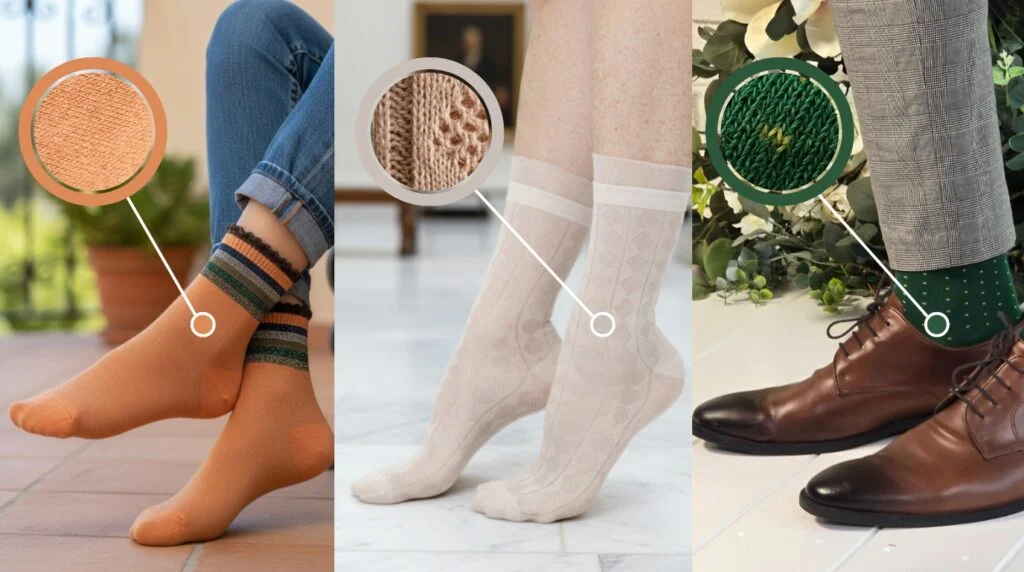
With all these options, choosing socks comes down to three questions asked in order. First: what shoes are you wearing? Low-cut shoes call for no-shows or ankle socks, mid-height shoes work with quarter or crew, and tall boots need crew or knee-highs. Second: what’s the occasion? Business and formal settings require at least crew-length dress socks where no bare skin shows; casual settings let you wear whatever length looks and feels good. Third: what’s the activity and weather? Cold weather and outdoor activities call for wool in longer lengths; hot weather favors lighter materials (cotton, bamboo) in shorter lengths; sports need moisture-wicking materials with support features.
If all else fails, a drawer stocked with these three types handles about 90% of life’s sock situations: quality ankle socks in cotton or bamboo for everyday casual wear, mid-calf merino wool socks for cold weather and outdoor activities, and a few pairs of fine-gauge crew or mid-calf socks in dark colors for business or dressy occasions. Everything else, novelty socks, athletic socks, compression socks, cozy home socks, fills specific niches as needed.
Frequently Asked Questions
What are the most common types of socks?
The most common sock types by length are ankle socks, crew socks, and no-show socks. By material, cotton socks are the most widely sold, followed by merino wool and synthetic blends. By purpose, everyday casual socks dominate the market, followed by athletic socks, dress socks, and compression socks. At Sokisahtel, ankle and crew length cotton socks are our highest-volume sellers, but merino wool socks have the highest customer satisfaction and reorder rate.
What type of socks should I wear with dress shoes?
Fine-gauge crew or mid-calf socks in combed cotton, merino wool, or silk blend. The cardinal rule: no bare skin should show between your trouser hem and your shoe when you sit down. Match sock color to your trousers (not your shoes) for the most polished look. Dark navy, charcoal, and black cover almost every formal situation.
What socks are best for sweaty feet?
Merino wool is the best overall material for sweaty feet due to its superior moisture wicking and natural antibacterial properties. Bamboo viscose is a close second, especially in warm weather. Avoid cotton, which absorbs moisture and holds it against your skin. For a deeper look at this topic, read our guide to the best socks for sweaty feet.
Are expensive socks worth it?
In our experience, yes, up to a point. Quality socks in the €8-15 range (merino blends, quality bamboo, well-made cotton) typically offer dramatically better comfort, fit, durability, and performance than €2-3 budget socks. Beyond €15-20, you’re paying for luxury materials (cashmere, silk) or designer branding, which is a personal choice rather than a practical necessity. The sweet spot for most people is a well-made merino or bamboo sock in the €8-12 range, noticeably better than cheap cotton, without the premium price of luxury.
How many pairs of socks should I own?
A practical minimum is 10-14 pairs for everyday rotation (allowing a full week plus washing time), plus 2-3 pairs each for specific activities (athletic, dress, cold weather). Many people get by with fewer by doing laundry more frequently, and wool socks can stretch intervals thanks to their odor resistance. At Sokisahtel, our gift sets are a convenient way to stock up on multiple pairs at a better price per pair.
Find Your Perfect Socks at Sokisahtel
With over 1,500 models from Estonian and European producers, Sokisahtel has been helping people find their perfect socks since 2010. Whether you need everyday basics, performance athletic socks, luxury wool for winter, or the perfect patterned pair for a gift, our collection covers every type discussed in this guide, and then some. We ship worldwide with free delivery on orders over €40.
→ Shop women’s socks | Shop men’s socks | Browse all collections
