Free shipping to parcel machines from 40 EUR Customer service Mon-Fri 9-19, Sat 10-18, Sun 10-17 | tel. 5551 0994 Discount coupon when you join our newsletter
EN ET RU

Category: Sock guides

  • Kids socks: the complete guide to finding the right pair for every age

    Kids socks: the complete guide to finding the right pair for every age

    Kids socks are one of those purchases that sounds impossibly simple — until you actually try to buy them. You open an online shop expecting to grab a pack and move on, only to find yourself staring at a wall of sizing labels, material blends, and style options that make zero sense. EU 23–26? US 6–8.5? Crew or ankle? Cotton or bamboo? Anti-slip dots or not? And that is before your child announces they will only wear socks with dinosaurs on them.

    The truth is, kids socks matter more than most parents realize. Children’s feet are developing rapidly, and the socks they wear affect everything from comfort and hygiene to how well their shoes fit. A poorly chosen sock can cause blisters, restrict circulation, or make a toddler slip on hardwood floors. A well-chosen one supports healthy foot development, keeps moisture at bay, and — if you pick a design your child actually likes — eliminates one of the seventeen daily battles involved in getting a kid dressed and out the door.

    This guide covers everything you need to know about buying socks for kids: how to nail the sizing, which materials work best, why non-slip socks for kids are more than a gimmick, and how to pick fun socks for kids that your children will actually want to put on their feet.

    Why kids socks deserve more attention than they get

    Adults can get away with mediocre socks. Kids are different. Their feet are still forming — bones are softer, skin is more sensitive, and the arches do not fully develop until around age six. According to the American Academy of Pediatrics, most children have flat feet in their early years, and proper footwear (socks included) plays a role in supporting natural development.

    Children’s socks also have to handle a level of activity that would destroy most adult socks within a week. Kids run, jump, slide, climb, and drag their feet on every surface imaginable. They sweat more per square centimeter than adults do, and they are far less likely to mention when something feels uncomfortable — they will just walk weirdly or refuse to put their socks on in the first place.

    Then there is hygiene. Kids’ feet spend long hours in shoes at school or daycare, creating a warm, moist environment that bacteria love. The right sock material makes an enormous difference here, which is why grabbing the cheapest multipack off a shelf is often a false economy.

    The kids sock size guide every parent needs

    Sizing is where most parents get lost. Children’s sock sizes vary by brand, by country, and by the age ranges manufacturers group together. A sock labeled “3–5 years” from one brand might fit completely differently than the same age label from another. The most reliable approach is to work from your child’s actual shoe size. For a deep dive into sizing across all age groups, our sock size chart covers every system and conversion you could need.

    Here is a quick reference for kids sock sizes by age, showing both EU and US sizing:

    Babies (0–1 year) wear EU sizes 15–19, which corresponds to US sizes 0–4. At this stage, baby socks essentially replace shoes — many pediatricians recommend that babies go barefoot or wear only socks indoors. Baby socks need to be snug enough to stay on (anyone who has raised a baby knows the mysterious disappearing-sock phenomenon) but not so tight that they leave marks on the skin.

    Toddlers (1–3 years) move into EU sizes 20–26, or US 5–9. This is the age where kids start walking, running, and testing every surface for its sliding potential. Toddler socks that are too big bunch up inside shoes and create friction points. Too small, and they restrict toe movement during a period when toes need room to grip and spread.

    Young kids (3–6 years) wear EU sizes 26–31, or US 9–13. Feet grow rapidly at this age — expect to replace kids socks every four to six months. Many parents buy a size up to get more wear, but oversized socks create wrinkles inside shoes that lead to blisters.

    Older kids (6–10 years) land in EU sizes 31–36, equivalent to US 13–4Y. By this point, kids are in school full-time and doing sports. This is also when kids start having opinions about what they wear, so visual appeal matters as much as fit.

    Tweens (10+ years) wear EU sizes 36–40, or US 4–7Y. Many tweens can transition into adult small sizes. Their feet are approaching adult proportions, but regular size checks remain important.

    The single most useful piece of advice for kids sock sizes: measure your child’s feet regularly. Kids’ feet can grow a full shoe size in just a few months. Stand your child on a piece of paper, trace around the foot, and measure the longest point. Then compare against the size chart for whichever brand you are buying.

    Materials that actually work for children’s socks

    The material your kids socks are made from matters just as much as the size. Children’s feet sweat — a lot. The International Hyperhidrosis Society notes that children’s sweat glands are concentrated in their hands and feet, making proper moisture management essential.

    Cotton is the classic choice and still the most popular material for children’s socks. It is soft, breathable, and gentle on sensitive skin. The downside is that 100% cotton absorbs moisture and holds it. A cotton-blend — usually with a small percentage of polyester and elastane — performs significantly better. The synthetic fibers add stretch, improve durability, and help the sock dry faster.

    Bamboo is naturally hypoallergenic and antibacterial, making it excellent for kids with sensitive skin or eczema. It wicks moisture more effectively than cotton and has natural temperature-regulating properties. Bamboo socks also tend to be exceptionally soft, which matters when you are dressing a toddler who protests anything that feels remotely scratchy.

    Merino wool is the unsung hero of children’s sock materials, particularly for winter. The fibers are much finer than traditional wool, creating a sock that is soft, breathable, and naturally temperature-regulating. Merino can absorb up to 30% of its weight in moisture without feeling wet, and it resists odor naturally. Our wool socks guide goes into much more detail about the benefits of wool for all ages.

    Synthetic blends — polyester, nylon, and elastane — show up in most athletic kids socks. They dry faster than any natural fiber and maintain their shape wash after wash. The trade-off is breathability: synthetics do not allow air to circulate as freely. For sports they are excellent; for everyday all-day wear, a natural fiber blend usually wins.

    When checking labels, look for roughly 70–80% natural fiber with 15–25% synthetic and 3–5% elastane. This combination gives you comfort and breathability with the stretch and durability kids need.

    Non-slip socks for kids: safety that actually matters

    Non-slip socks for kids are not just a nice-to-have — for babies and toddlers, they are a safety essential. Those little silicone or rubber grip dots on the sole of a sock can be the difference between a toddler walking confidently across tile and the same toddler taking a spectacular tumble.

    The need for grip is highest between ages 0 and 4, when children are learning to walk and navigate different surfaces. Hardwood floors, tile, and laminate are all surprisingly slippery for small feet in regular socks. Daycares and play centers often require non-slip kids socks specifically for this reason.

    When shopping, check that the grip material covers a substantial area of the sole — not just a small patch. Full-sole coverage provides the most stability. Silicone dots tend to hold up better than rubber patterns through multiple washes. For older kids, non-slip features remain useful for sleepovers, trampoline parks, and martial arts classes.

    Fun socks for kids: designs that make getting dressed easier

    Here is a parenting hack that no one tells you about until you are in the trenches: a child who likes their kids socks will put them on without a fight. If you have ever spent fifteen minutes negotiating with a three-year-old about putting on a plain white sock, you understand the transformative power of a dinosaur or a rainbow.

    Fun socks for kids turn getting dressed into something a child looks forward to. When a kid picks between the rocket ship socks and the puppy socks, they feel autonomy and excitement about an activity that would otherwise be a battle of wills.

    Animal designs are the most popular category for children’s socks. Dinosaurs, cats, dogs, sharks, unicorns — the appeal is universal. Our animal socks collection includes designs kids go crazy for, and our animal socks guide explains why these designs work so well for all ages.

    Bright colors and patterns are another winner. Children are naturally drawn to bold, saturated colors. Stripes, polka dots, rainbow gradients, and geometric patterns all perform well with kids who want their feet to be as loud as their personalities. Our guide to colorful socks explores how bold color choices brighten any wardrobe.

    Themed and character socks tap into whatever your child is currently obsessed with — space, sports, food prints, vehicles, or seasonal motifs. Wearing socks that reflect something they love is a small but meaningful form of self-expression.

    Mismatched socks have become a trend in themselves. Some brands sell kids socks in deliberately mismatched pairs — same theme, different design on each foot. Kids love it, and it solves the age-old problem of losing one sock from a pair.

    When building a kids sock collection, variety is your friend. Sock packs that include multiple designs are a practical way to stock up while giving kids enough options to feel in control.

    Boys socks and girls socks: does the label matter?

    Functionally, boys socks and girls socks are identical — same materials, same sizing, same construction. The only difference is design: color palettes and motifs that brands have traditionally associated with one gender or the other.

    Kids often have preferences, and there is nothing wrong with honoring them. Some boys want trucks and footballs, some girls want sparkly unicorns, and plenty of kids of any gender want dinosaurs or cats. Let your child’s interests guide the decision rather than a marketing label.

    At Sokisahtel, our girls’ socks collection and boys’ socks collection are organized by design theme, making it easy to find what your child actually wants.

    School socks and sport socks for kids

    School socks might be the hardest-working item in your child’s wardrobe. They go on early, endure classroom fidgeting, full-speed recess, possibly PE, and then after-school activities — five days a week, forty weeks a year. For everyday school wear, a cotton-blend crew sock in a medium weight hits the sweet spot. Reinforced heels and toes are worth seeking out, as these areas wear through first.

    If your child’s school requires specific sock colors, buy more pairs than you think you need — the socks-to-school-days ratio should be at least 7:5. Ankle socks work well for warmer months, while crew-length kids socks provide more coverage in winter. Our guide to sock lengths explains the differences, and the types of socks guide covers every style available.

    Sport socks for kids need to match the activity. Running and general athletics call for lightweight, moisture-wicking socks with a snug fit and smooth toe seam — seamless construction is worth the extra cost for texture-sensitive kids. Soccer requires knee-high socks that work with shin guards. Dance and gymnastics often need specific styles like grip socks or split-sole ballet socks. For multi-sport kids, a solid rotation of athletic-weight moisture-wicking socks with reinforced heels and toes covers most bases.

    Seasonal kids socks: from summer to winter

    Kids socks should rotate with the seasons. Spring and summer call for lightweight, breathable ankle socks in thin cotton or bamboo blends — they let air circulate and dry quickly. Light colors are practical in warm weather, and this is prime territory for funny socks with ice cream cones and watermelon prints.

    Autumn and winter demand crew-length kids socks in heavier materials. When temperatures drop, merino wool and thick terry-loop cotton socks earn their place. Layer a thin moisture-wicking sock under a thicker wool sock for maximum warmth on the coldest days. For the holiday season, kids’ Christmas socks make festive wardrobe additions and easy stocking stuffers.

    Speaking of gift-giving, kids socks are genuinely one of the best small gifts for children — practical, affordable, always needed, and when you pick a fun design, kids actually get excited. Our socks as gifts guide has more ideas for every occasion.

    Baby socks: a special case

    Baby socks deserve a separate mention because shopping for them is an entirely different experience. Babies cannot tell you that a sock is too tight, itchy, or uncomfortable.

    The top priority is safety and gentleness. Choose soft natural materials — organic cotton and bamboo are ideal — with flat seams that will not irritate delicate skin. Avoid tight elastic bands at the top, as these can leave marks and restrict circulation in tiny legs. Look for gentle, stretchy cuffs that stay on without squeezing.

    Staying on is the eternal challenge. Babies are remarkable sock-removal artists. Socks with a slightly longer cuff that folds over tend to stay put better, as do designs with a gentle grip band woven into the cuff. Non-slip features become essential once a baby starts pulling themselves up and cruising along furniture, typically around 8–12 months.

    How to care for kids socks so they last

    Getting the most life out of children’s socks requires a little care. Wash kids socks inside out — this protects the design and exposes the dirtier inside to detergent. Use a warm cycle; hot water shrinks natural fibers and breaks down elastic. Skip fabric softener, which coats fibers with a waxy residue that reduces moisture-wicking. Tumble dry on low or air dry — high heat is the number one killer of sock elastic. And pair them immediately out of the dryer to preserve your sanity. Some parents use mesh laundry bags to keep socks together through the wash.

    Kids socks with holes, stretched-out elastic, or worn grip dots should be retired. Once a sock starts to fail, it deteriorates quickly, and worn-out socks offer less cushioning, less moisture management, and less safety.

    Find the perfect kids socks at Sokisahtel

    A well-stocked kids sock drawer needs about ten to twelve pairs in active rotation: everyday fun designs for school, a few athletic pairs for sports, warm winter socks, and non-slip socks for indoor play. Refresh every season, retiring worn pairs and checking that sizes still fit. For design inspiration, our guides to novelty socks and colorful socks are full of ideas that work beautifully for kids.

    At Sokisahtel, we stock a wide range of children’s socks designed with fit, comfort, and fun in mind — from playful animal socks that make getting dressed an adventure to practical everyday pairs that survive whatever your kids throw at them. Browse our collections for girls, boys, and babies, and check our sock size chart to make sure you are getting the perfect fit. Because life is too short for boring socks — especially when you are six years old and the socks have sharks on them.
  • Sock Lengths Explained: The Complete Guide to Every Sock Height

    Sock Lengths Explained: The Complete Guide to Every Sock Height

    You’d think choosing a sock would be simple, grab a pair, pull them on, get on with your day. But if you’ve ever worn ankle socks with hiking boots and spent the afternoon with raw, rubbed skin above your shoe line, or sat down at a business lunch only to realize your trousers have ridden up to reveal a gap of bare leg above your too-short socks, you know that sock length matters. It matters more than most people realize, and getting it right is one of those small details that separates a comfortable, put-together outfit from one that nags at you all day.

    At Sokisahtel, we sell over 1,500 sock models across every length from invisible no-shows to dramatic thigh-highs, and length is consistently the most misunderstood element of sock shopping. People focus on color and material (both important!) but default to whatever length they’ve always bought without considering whether it’s actually right for their shoes, their outfit, or their activity. This guide breaks down every sock length with honest, specific advice on when each one works, and when it doesn’t.

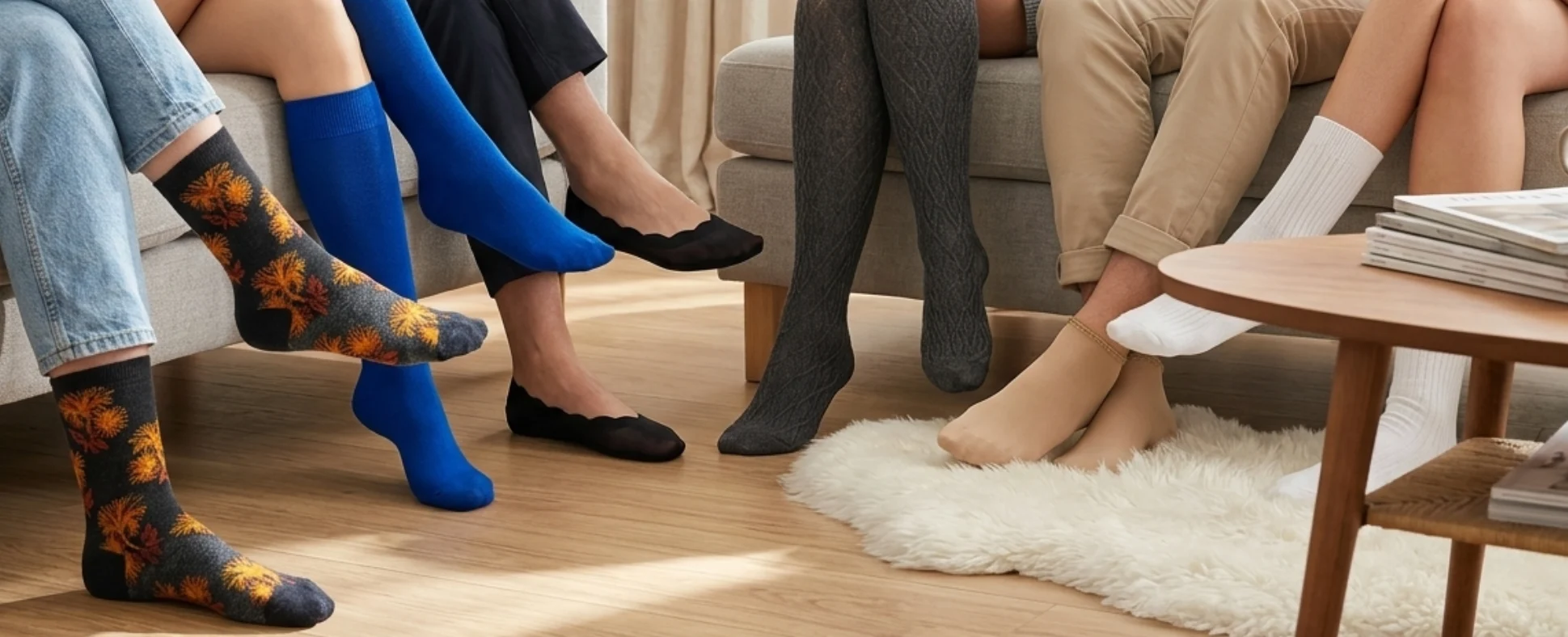
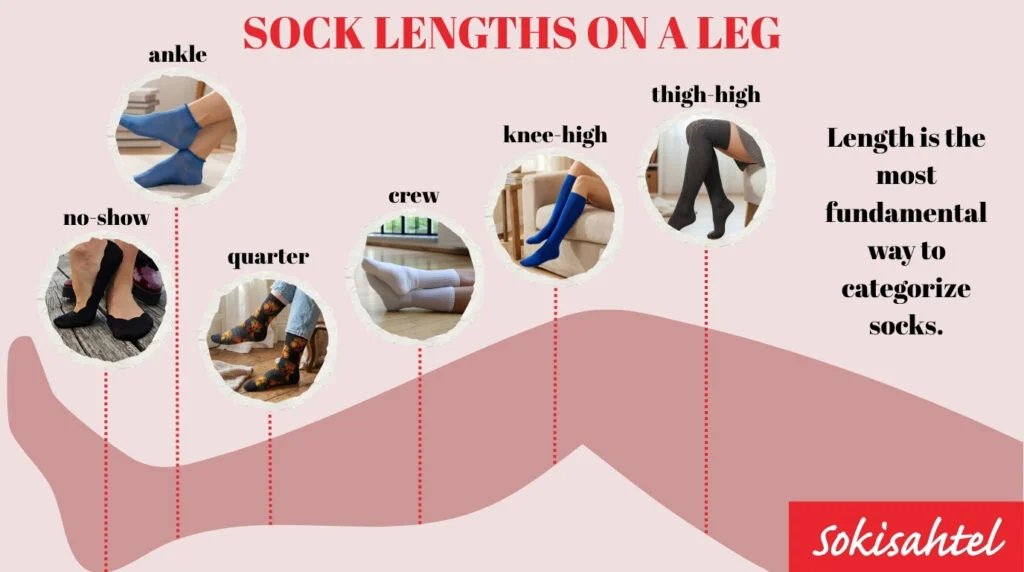
    Guide to sock lengths comparing no-show, ankle, quarter, crew, knee-high, and thigh-high styles.

    What Do We Mean by “Sock Length”?

    Sock length simply refers to how high the sock reaches on your leg, measured from the sole of your foot upward. Standard sock lengths range from invisible no-shows that disappear inside your shoe to over-the-knee styles that reach your mid-thigh. Each length exists because it solves a specific problem, whether that’s preventing shoe rubbing, keeping legs warm, meeting dress code requirements, or making a fashion statement. There’s no universally “best” length; there’s only the right length for what you’re wearing, where you’re going, and what you’re doing.

    The lengths below are listed from shortest to tallest. For each, we’ll tell you the approximate height, what shoes and occasions it works best with, common mistakes to avoid, and our honest take based on years of fitting customers at Sokisahtel.

    No-Show Socks (Invisible / Liner Socks)

    Height: Below the shoe line, completely hidden when wearing shoes.

    No-show socks were invented to solve a specific fashion problem: people want to wear loafers, boat shoes, and low-cut sneakers with the appearance of bare feet, but actually going barefoot in shoes is a genuinely terrible idea. Without any barrier between your foot and the shoe, you get blisters from friction, excessive sweating that soaks into (and eventually destroys) the shoe lining, rapid odor buildup that no amount of airing out can fix, and a generally unpleasant experience for your feet. No-shows give you the visual of bare ankles with the practical benefits of a sock, moisture absorption, friction reduction, and protection for both your feet and your shoes.

    The quality difference in no-show socks is enormous. Cheap ones, and we’ve all experienced this, slip off the heel within an hour and bunch up under your arch, defeating the entire purpose. Quality no-shows have a silicone grip strip along the heel that keeps them anchored to your foot all day. This one feature is the difference between a good experience and a maddening one. Our footies and liner sock collection is curated specifically for grip quality, because there’s no point selling an invisible sock that won’t stay invisible.

    Best paired with: Loafers, boat shoes, low-top sneakers, slip-ons, moccasins, ballet flats, espadrilles. Ideal for summer with cropped trousers, shorts, skirts, or any outfit where the sockless look is part of the aesthetic.

    When to avoid: High-top shoes (the sock bunches uselessly inside), cold weather (your exposed ankles will make the rest of your outfit irrelevant), and any athletic activity where you need ankle support or blister protection above the shoe line.

    Ankle Socks (Low-Cut Socks)

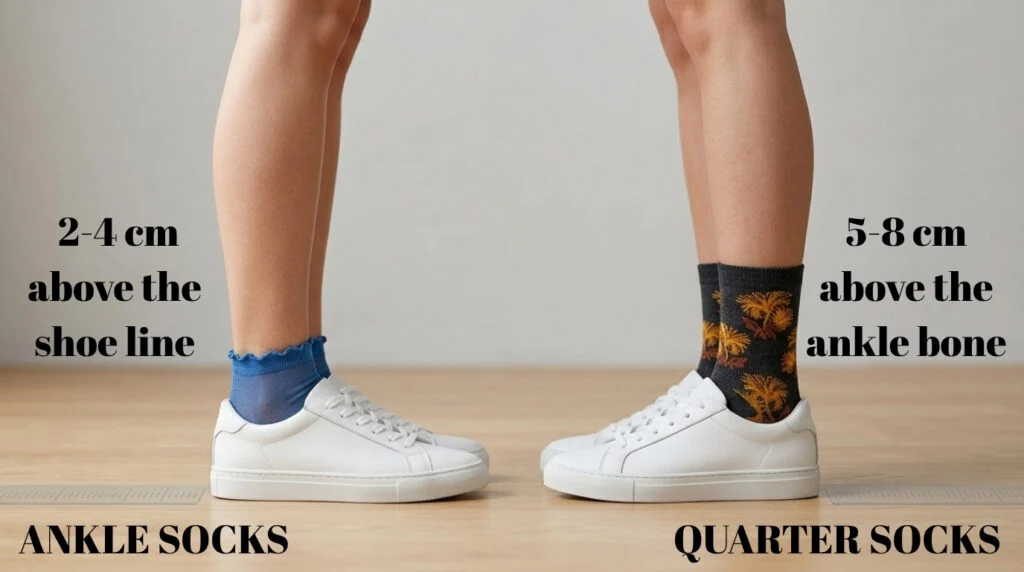
    Height: Just above the ankle bone, approximately 2-4 cm above the shoe line.

    Ankle socks are the default. They’re the pair you reach for without thinking on a normal Tuesday morning, the ones that fill multipacks at every clothing store, and the length that most people default to for casual wear. There’s nothing wrong with that, ankle socks are genuinely versatile. They work with sneakers, trainers, casual shoes, and most everyday footwear. They provide a thin visible band above the shoe that reads as casual and sporty without demanding any attention. They’re comfortable, easy, and inoffensive.

    Where ankle socks fall short, literally, is protection. They cover the ankle bone but leave everything above it exposed, which means your skin is vulnerable to rubbing from shoe collars, boot tops, and anything that sits higher than a typical sneaker. For this reason, ankle socks aren’t ideal for hiking boots, work boots, or any shoe with a collar that extends above the ankle. They also provide minimal warmth in cold weather, since your lower calf is bare. For gym workouts, casual outings, errands, and warm-weather daily wear, ankle socks are hard to beat. Our women’s sock selection and men’s range include plenty of quality ankle options in cotton, bamboo, and merino.

    Quarter Socks

    Height: About 5-8 cm above the ankle bone, roughly one quarter of the way up your calf.

    Quarter socks are the “upgrade” length that most people haven’t tried yet, and once they do, many switch permanently for athletic use. The extra few centimeters above a standard ankle sock don’t look dramatically different, but they solve a real functional problem: protecting the Achilles tendon and lower ankle area from shoe rubbing. If you’ve ever developed a blister or raw spot where the back of your shoe meets your skin, a quarter sock would likely have prevented it.

    This length has become the de facto standard for many athletic brands. Nike, Adidas, and most serious running brands now sell more quarter socks than ankle socks in their performance lines, because athletes discovered that the slight extra height makes a tangible difference in comfort and blister prevention during movement. For tennis, running, cross-training, golf, and any sport involving footwork, quarter socks are worth trying if you’ve been defaulting to ankle socks. They also look sharp with low-to-mid-top sneakers in casual settings, visible enough to register as intentional, not so high as to look like your dad’s exercise socks. Check our athletic socks for quality quarter-length options.

    Sock lengths comparison showing ankle socks and quarter socks with their height differences.

    Crew Socks

    Height: Mid-calf, approximately 15-20 cm above the ankle bone.

    If socks had a “universal mode,” it would be crew length. Crew socks are the all-purpose, all-season, all-occasion length that works almost everywhere. They hit roughly halfway up your calf, high enough to provide real warmth and protection, low enough to stay hidden under most trousers. For business and formal settings, crew length is the minimum you should consider: when you sit down and your trouser leg rides up, there should be no visible gap of bare skin between sock and hem. Dark crew socks in navy, black, or charcoal are wardrobe essentials that every adult should own.

    But crew socks aren’t just for formal situations, they’ve experienced a genuine fashion renaissance. The visible crew sock, pulled up deliberately with sneakers and shorts, has gone from fashion faux pas to streetwear staple. White crew socks with chunky sneakers, bold-colored crew socks peeking above boot tops, patterned crew socks adding personality to an otherwise simple outfit, the versatility is remarkable. Add cold-weather functionality (crew socks keep your lower calf insulated against drafts) and outdoor practicality (they prevent hiking boots from rubbing against bare skin), and you have a length that earns its reputation as the most versatile. If you’re building a sock drawer from scratch, start with crew. Browse our full collection for crew socks in every material and style.

    Mid-Calf Socks

    Height: At the widest part of the calf, approximately 20-25 cm above the ankle bone.

    Mid-calf socks sit slightly higher than crew, reaching the thickest part of your calf muscle. This is the traditional length for high-quality dress socks, and there’s a specific engineering reason: the wider part of the calf provides a natural anchor point for the elastic cuff, which means mid-calf socks stay up better throughout the day without needing to grip tightly. A well-fitting mid-calf sock essentially locks in place and doesn’t budge, even if you’re on your feet all day, which is why professionals who need their socks to look perfect from morning to evening (think bankers, lawyers, politicians) have traditionally gravitated toward this length.

    Mid-calf socks are also the preferred length for serious hiking and winter sports, where the extra coverage means extra warmth and protection. The difference between a crew sock and a mid-calf sock inside a tall hiking boot is subtle but noticeable, the mid-calf sock eliminates any possibility of the boot collar touching bare skin, even during extended downhill descents when socks tend to compress and slide down slightly. For our wool sock collection, we stock many styles in mid-calf specifically because our customers in Estonia, Scandinavia, and Northern Europe need that extra coverage for harsh winters.

    Knee-High Socks

    Height: Just below the knee, approximately 35-40 cm above the ankle bone.

    Knee-high socks serve two distinct worlds: functional and fashionable. On the functional side, knee-highs are essential for tall boots (riding boots, fashion boots, winter boots that extend to the knee), wearing a shorter sock inside a tall boot creates an uncomfortable line of pressure where the sock ends and exposes bare skin to the boot interior.

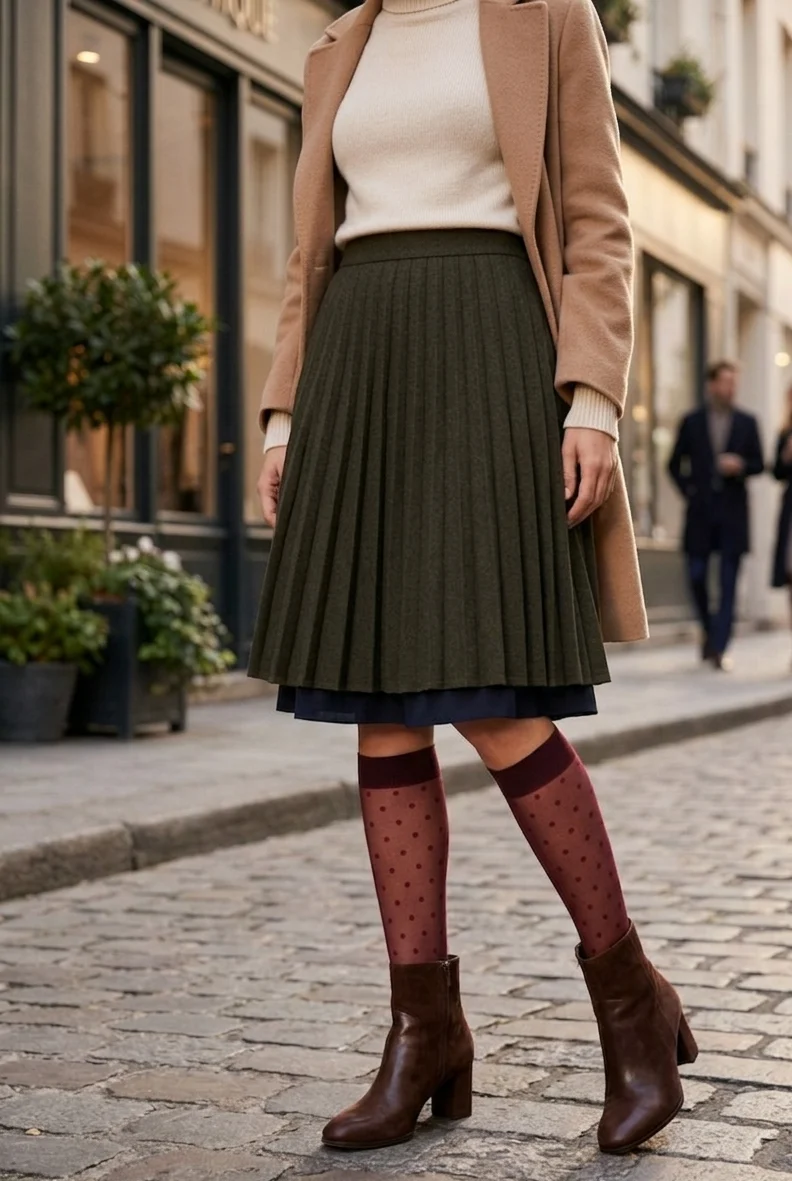
    Fashion outfit showing taller sock lengths styled with a pleated skirt and ankle boots.

    Knee-highs also dominate specific sports: football, rugby, cycling, and equestrian activities all use knee-length socks as standard equipment. In the medical space, knee-high compression stockings are the most commonly prescribed length for circulatory support.

    On the fashion side, knee-highs paired with skirts and dresses create a look that can range from schoolgirl preppy to chic European sophistication, depending on the material and styling. Sheer knee-highs under a business suit skirt are a classic professional look. Cable-knit wool knee-highs with a short skirt and boots are a perennial autumn/winter favorite. Our knee-high collection for women includes both practical everyday options and stylish Pierre Mantoux designs for when you want your socks to make a statement.

    Fit tip: Knee-high socks should have a comfortable elastic band at the top that holds them just below the knee without digging into your skin or leaving red marks. If you’re buying compression knee-highs, proper sizing is critical, measure your calf at its widest point and consult the brand’s size chart, because too-tight compression can actually restrict circulation rather than improve it.

    Over-the-Knee and Thigh-High Socks

    Height: Above the knee, extending to mid-thigh or higher.

    Over-the-knee socks are pure fashion territory. They make a bold visual statement, there’s nothing subtle about a pair of thigh-highs, and they’ve been a recurring trend in fall/winter fashion for over a decade. Cozy cable-knit thigh-highs in wool or cotton pair with short skirts and ankle boots for an autumn look that’s simultaneously warm and eye-catching. Sleek, fitted versions in fine knit or with lace details lean more evening and dramatic. They’re popular in dance, performance, and costume contexts as well.

    The practical challenge is keeping them up. Gravity and movement conspire against thigh-highs, which is why quality matters especially at this length. Look for versions with wide silicone grip bands at the top, these create enough friction to hold the sock in place through a full day of movement. For a more secure option, pair them with a garter belt, which adds a vintage-chic element to the look. Our hold-ups and thigh-high collection from Pierre Mantoux includes Italian-designed options with quality grip bands that actually stay where you put them.

    Sock Length Quick Reference Chart

    Sock Length Height Best Shoes Best Occasions Our Pick
    No-Show Below shoe line Loafers, low-top sneakers, boat shoes Summer, casual, sockless look Footies
    Ankle 2-4 cm above ankle Sneakers, trainers, casual shoes Everyday casual, gym Women’s socks
    Quarter 5-8 cm above ankle Running shoes, tennis shoes Sports, athletic training Athletic socks
    Crew Mid-calf (15-20 cm) Boots, dress shoes, sneakers Most versatile, everything Browse all
    Mid-Calf Widest part of calf Dress shoes, tall shoes Business, formal, hiking Wool socks
    Knee-High Below the knee Tall boots, football boots Sports, fashion, uniforms Knee-highs
    Thigh-High Above the knee Short boots, heels Fashion, loungewear Hold-ups

    How to Choose the Right Sock Length: The Sokisahtel Method

    After helping thousands of customers pick the right socks, we’ve distilled the decision into three questions that you should ask in this order.

    First: what shoes are you wearing? This is the most important factor. Low-cut shoes (loafers, sneakers, slip-ons) pair with no-show or ankle socks. Mid-height shoes (chukka boots, high-top sneakers) work best with quarter or crew socks. Tall boots (hiking boots, riding boots, winter boots) need knee-high or at least crew-length socks to prevent rubbing. If you’re not sure, err on the side of longer, you can always fold a sock down, but you can’t stretch a short sock higher.

    Second: what’s the dress code? Business, formal, and professional settings require at minimum crew length in dark, solid colors. No bare skin should ever show between your trouser hem and your shoe, this is one of those unwritten rules that people absolutely notice when you break it. Casual settings are completely forgiving; wear whatever length looks good and feels comfortable.

    Third: what’s the weather and activity? Hot weather calls for shorter, lighter socks (no-show, ankle) in breathable materials. Cold weather calls for longer socks (crew, mid-calf, knee-high) in insulating materials like merino wool. Athletic activities benefit from the specific features of quarter or crew athletic socks with moisture wicking and support structures. If you’re not sure which material, our wool sock guide helps with cold-weather decisions, and our sweaty feet guide covers warm-weather material choices.

    Frequently Asked Questions

    What sock length should I wear with suits?

    Mid-calf is the traditional and safest choice, these socks reach the widest part of your calf and stay up reliably all day. Crew length is also acceptable if it’s long enough that no bare skin shows when you sit and cross your legs. Match your sock color to your trouser color (not your shoes) for the most polished look. Navy trousers get navy socks; charcoal trousers get charcoal socks; black trousers get black socks.

    Are crew socks too long for sneakers?

    Not at all, this is actually one of the strongest current trends in casual and streetwear fashion. Crew socks pulled up with sneakers and shorts is a deliberate style choice that’s been popular since around 2020 and shows no signs of fading. The key is commitment: pull them up fully and let them be visible. Half-pulled-up socks scrunched at the ankle look sloppy; fully extended crew socks look intentional and put-together.

    What’s the difference between ankle socks and quarter socks?

    Ankle socks sit right at or just above the ankle bone (2-4 cm above the shoe). Quarter socks extend about 5-8 cm higher, covering the lower Achilles area. The practical difference is protection: quarter socks prevent the blisters and irritation that form when a shoe collar rubs against the bare skin above an ankle sock. Most athletic brands now prefer quarter length as their standard sport sock for this reason.

    Can men wear knee-high socks?

    Absolutely. Men’s knee-high socks are standard in football, rugby, cycling, and equestrian sports. Compression knee-highs are widely worn by men for travel, medical purposes, and post-exercise recovery. In everyday fashion, men’s knee-highs are less common but perfectly acceptable when the outfit and occasion call for them, particularly with tall boots in winter.

    What sock length is best for running?

    Most runners prefer quarter or ankle length. Quarter socks have a slight edge because the extra fabric protects the Achilles area from shoe rubbing, which becomes increasingly important over longer distances. For trail running and cold weather, crew socks provide more warmth and prevent trail debris from entering the shoe. Whatever length you choose, make sure the material is moisture-wicking, merino wool or synthetic blends, not cotton.

    Find Every Sock Length at Sokisahtel

    From invisible no-shows to dramatic thigh-highs, our collection covers every length in every material, cotton, merino wool, bamboo, compression, and more. We’ve been helping people find the right socks in Estonia and across Europe since 2010, and with over 1,500 models and free shipping on orders over €40, there’s a good chance we have exactly what you’re looking for.

    → Browse our collection

  • Wool Socks: The Ultimate Guide to Warmth, Comfort, and Style

    Wool Socks: The Ultimate Guide to Warmth, Comfort, and Style

    If you’ve ever pulled on a pair of thick cotton socks on a cold morning and still ended up with frozen toes by lunchtime, you already know the frustration. Cotton looks cozy, feels familiar, and costs next to nothing, but it fails at the one job a winter sock needs to do: keep your feet warm when conditions turn against you. That’s where wool comes in, and more specifically, where merino wool changes the game entirely.

    At Sokisahtel, we’ve been selling socks since 2010, and if there’s one lesson we’ve learned from thousands of customer conversations, it’s this: once someone tries a good pair of wool socks, they never go back to cotton for cold weather. Not once. We carry merino, alpaca, angora, and cashmere wool socks because we’ve seen firsthand how the right wool transforms the way people feel about their feet, in Estonian winters and beyond.

    This guide covers everything worth knowing about wool socks: why they outperform every other material, what separates merino from alpaca from angora, how to pick the right pair for hiking versus office wear versus lounging at home, and how to care for them so they last for years. Whether you’re a complete wool skeptic or already a convert looking to upgrade, you’ll find answers here.

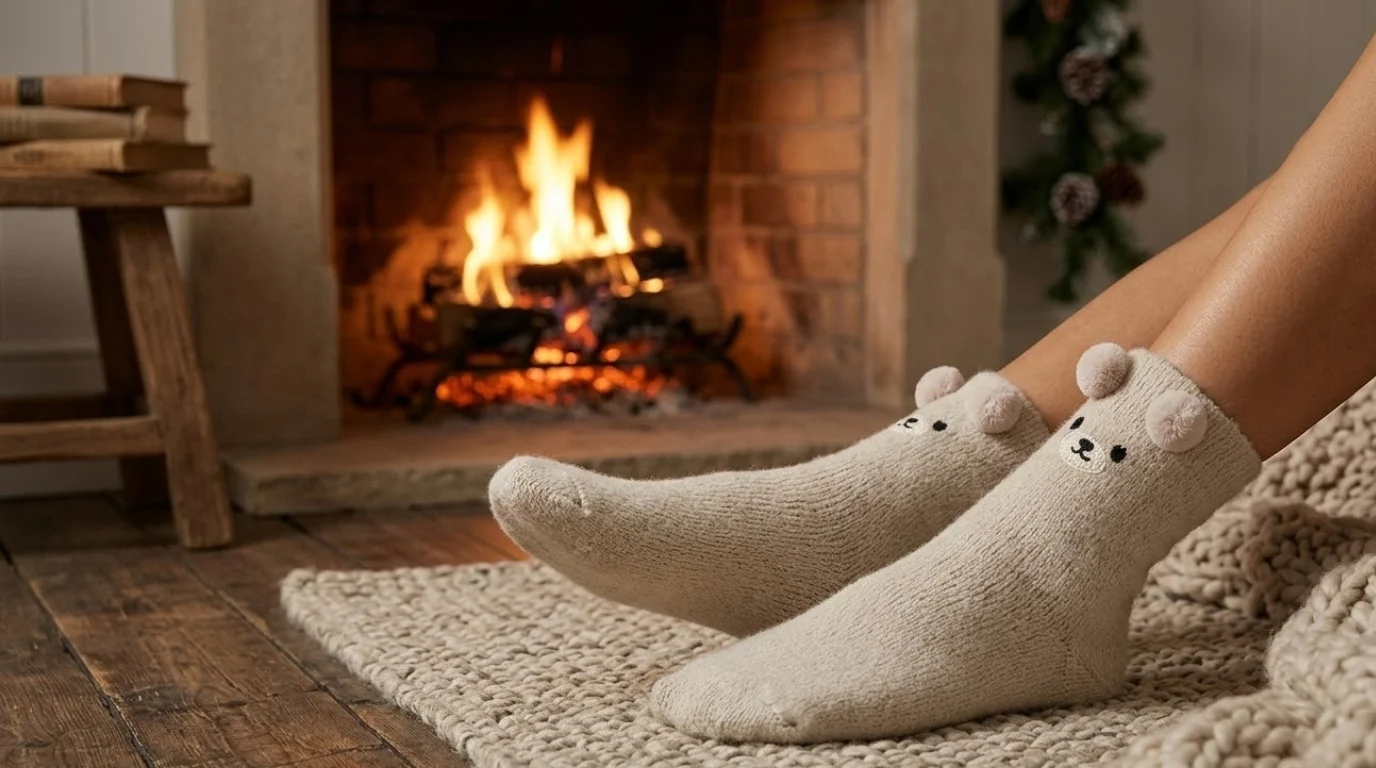
    Person wearing cozy cream wool socks with bear faces while relaxing by a warm fireplace.

    Why Wool Socks? What Makes Them Different from Everything Else

    The question isn’t really “why wool?”, it’s “why did it take us so long to figure out what sheep have known for millennia?” Wool is the original performance fabric. Long before anyone invented CoolMax or Dri-FIT, wool was quietly doing everything those synthetic technologies try to replicate: regulating temperature, managing moisture, resisting odor, and lasting through years of hard use. The difference is that wool does all of it simultaneously, naturally, and without any chemical treatments.

    Temperature Regulation That Actually Works Both Ways

    Here’s something that surprises most people: wool socks aren’t just for winter. The fiber structure of wool creates millions of tiny air pockets that trap warmth when it’s cold outside, but these same pockets allow excess heat and moisture to escape when temperatures rise. It’s a natural thermostat that no synthetic fiber has fully matched. This is why shepherds in Scotland and farmers in Australia, two wildly different climates, have both relied on wool for centuries. Your feet stay warm at -15°C and comfortable at +25°C in the same pair of socks. We’ve had customers in Tallinn tell us they started wearing their merino wool socks year-round after one summer, because even on hot July days, their feet stayed cooler and drier than in cotton.

    Moisture Management: The Reason Your Cotton Socks Feel Clammy

    Your feet produce roughly half a pint of sweat per day, more during exercise, stress, or warm weather. Cotton absorbs this moisture like a sponge and holds onto it, pressing wet fabric against your skin for hours. The result? That cold, clammy feeling in winter. Blisters during hikes. Bacteria thriving in the dampness, producing that unmistakable sock smell by the end of the day.

    Wool works completely differently. It can absorb up to 30% of its own weight in moisture before it starts to feel even slightly damp. More importantly, it doesn’t just sit there holding the water, wool actively moves moisture from the skin surface to the outer layer of the fabric, where it evaporates into the air. The technical term is “moisture wicking,” and wool does it better than any other natural fiber. Your skin stays dry, friction drops, blisters don’t form, and the bacteria that cause odor simply can’t get a foothold in the dry environment next to your skin.

    Natural Odor Resistance (Yes, You Can Wear Them Multiple Days)

    This is the benefit that converts the most skeptics. Wool fibers contain lanolin, a natural wax produced by sheep, that has genuine antibacterial properties. It actively inhibits the growth of the bacteria responsible for foot odor. The practical result? You can wear a good pair of merino wool socks for two, sometimes three days before they develop any noticeable smell. Try that with cotton and you’ll clear a room. Hikers and long-distance travelers figured this out years ago, and it’s one of the main reasons serious outdoor brands have almost universally switched from cotton to merino for their sock lines. For everyday life, it means fewer socks in the laundry basket and less time washing.

    Durability That Justifies the Price

    Quality wool fibers can bend more than 20,000 times before they break. Cotton fibers give up after about 3,000 bends. This isn’t a marginal difference, it’s an order of magnitude. In practical terms, it means that a well-made pair of wool socks will hold its shape, maintain its cushioning, and keep performing for 2-5 years of regular wear. Cotton socks thin out, lose their elasticity, and develop holes far sooner. When you divide the price by the number of wears, wool socks often end up costing less per wear than their cheaper cotton alternatives. At Sokisahtel, we’ve had customers come back for the same merino socks three years later, not because the first pair wore out, but because they wanted more pairs in different colors.

    Side-by-side comparison of worn cotton socks and patterned wool socks showing better durability and appearance.

    Types of Wool: From Budget-Friendly to Pure Luxury

    Not all wool is created equal. The type of animal, the breed, and even the specific part of the fleece determine how soft, warm, and durable the resulting sock will be. Here’s what you’ll encounter when shopping for wool socks, roughly ordered from most common to most luxurious.

    Merino Wool, The One We Recommend Most Often

    Merino wool comes from Merino sheep, originally bred in Spain and now raised primarily in Australia and New Zealand. What makes merino special is the fineness of its fibers, typically 15-24 microns in diameter, compared to 25-40 microns for regular sheep’s wool. That difference might sound academic, but you feel it instantly when you put on a merino sock: it’s soft, smooth, and nothing like the scratchy wool sweater your grandmother knitted.

    Merino is the gold standard for sock production because it combines every advantage of wool, temperature regulation, moisture wicking, odor resistance, durability, with a next-to-skin comfort that rivals cashmere at a fraction of the price. If you’ve avoided wool socks your entire life because you assumed they’d be itchy, merino is the one that will change your mind. It’s the type we sell the most at Sokisahtel, and the one we personally wear through Estonian winters. Browse our merino wool sock collection to see the full range.

    Traditional Sheep’s Wool, Maximum Warmth, Honest Price

    Regular sheep’s wool uses thicker fibers (25-40 microns) that provide outstanding insulation but feel noticeably coarser against the skin. These are the chunky, rugged socks your grandparents wore, and there’s a good reason they’ve been around for centuries. When maximum warmth is the priority and you don’t mind a bit of texture, traditional wool socks deliver incredible value. They’re perfect for wearing inside boots where the sock isn’t directly rubbing against sensitive skin, or for layering over a thinner liner sock during extreme cold. They’re also significantly cheaper than merino, making them a practical everyday choice for outdoor work in winter.

    Alpaca Wool, Lightweight Warmth for Sensitive Skin

    Alpaca fiber is genuinely remarkable. It’s hollow, unlike sheep’s wool, which is solid, which makes it lighter and warmer per gram than almost any other natural fiber. Alpaca wool is also naturally hypoallergenic because it contains no lanolin, making it the best option for people who experience skin reactions to sheep’s wool. The texture is silky and soft, somewhere between merino and cashmere in feel, and it drapes beautifully in a knitted sock. The downside is price, alpaca socks are a premium product, and slightly less elasticity than merino, so they can lose their shape faster if not cared for properly. We carry a selection of alpaca wool socks for customers who want that combination of extreme softness and hypoallergenic properties.

    Angora Wool, The Softest You’ll Ever Feel

    Sourced from Angora rabbits, this fiber is in a class by itself when it comes to pure softness. Angora has a distinctive fluffy, almost cloud-like texture that feels incredibly luxurious against the skin. It’s also very warm for its weight. The catch is that pure angora is fragile and pills easily, which is why it’s almost always blended with merino or nylon to add structure and durability. Angora blend socks are best for low-activity, indoor wear, curled up on the couch, padding around the house on a Sunday morning. They make exceptional gifts because the softness factor is immediately obvious the moment someone pulls them out of the box. You’ll find angora blend socks in our wool collection.

    Cashmere, Pure Indulgence

    Cashmere comes from the undercoat of cashmere goats and is the finest, lightest, and most expensive wool available. Cashmere socks feel like wearing a whisper, impossibly soft, feather-light, and warm beyond what their thinness would suggest. They’re also the least durable option on this list, which is why they’re best treated as a luxury item rather than an everyday workhorse. A pair of cashmere socks is the kind of gift that makes someone’s eyes widen when they feel the fabric. Not for hiking. Not for the gym. But for a cold evening at home with a glass of wine? Unbeatable.

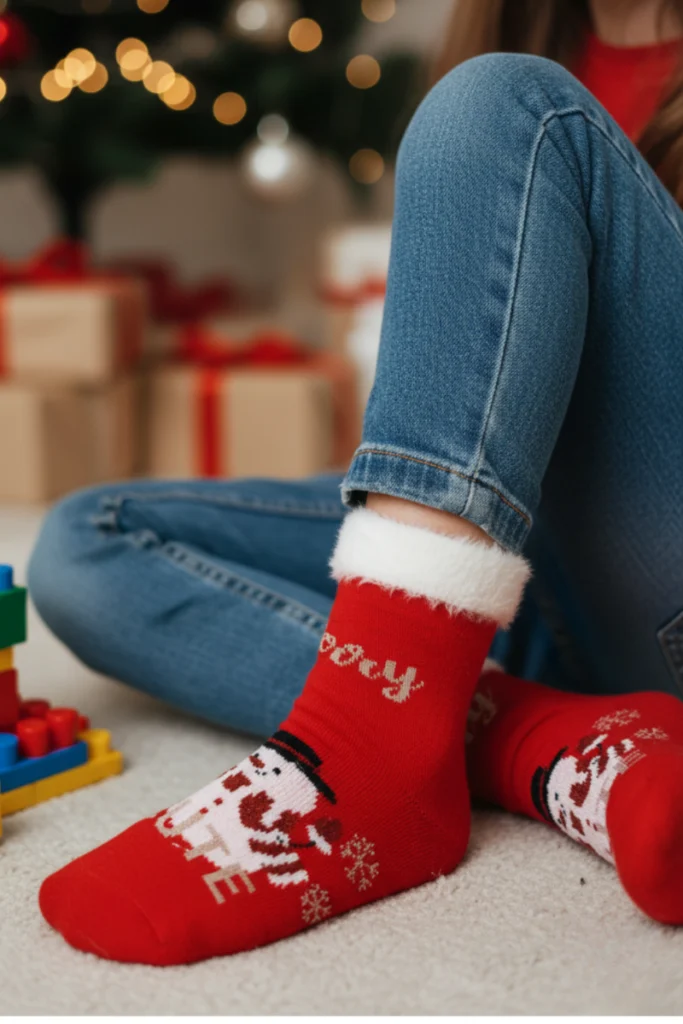
    Person in jeans wearing red festive wool socks with white cuffs and holiday pattern beside Christmas gifts.
    Traditional wool socks
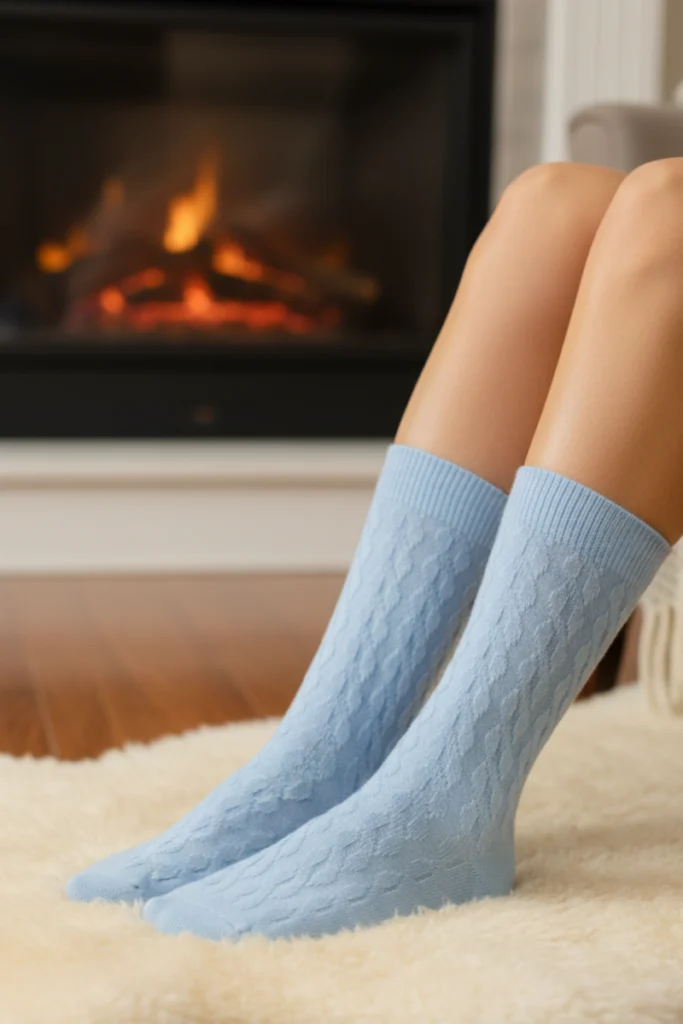
    Person wearing light blue cable-knit cashmere wool socks on a soft rug in front of a glowing fireplace.
    Luxurious cashmere socks
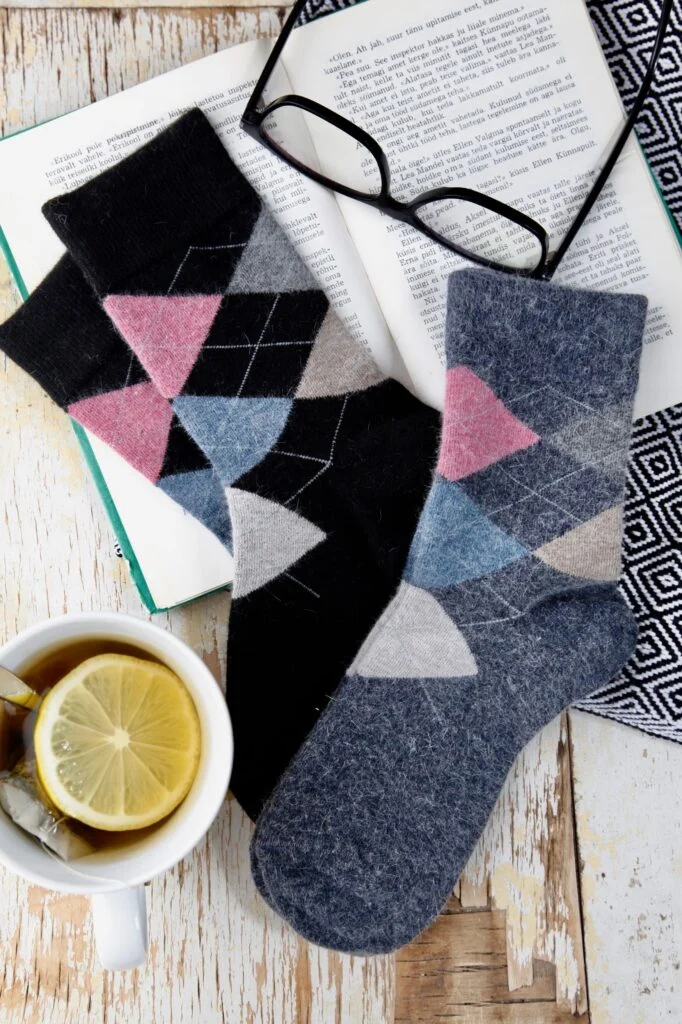
    Patterned angora wool socks beside an open book, glasses, and a cup of tea create a cozy reading scene.
    Fluffy angora socks
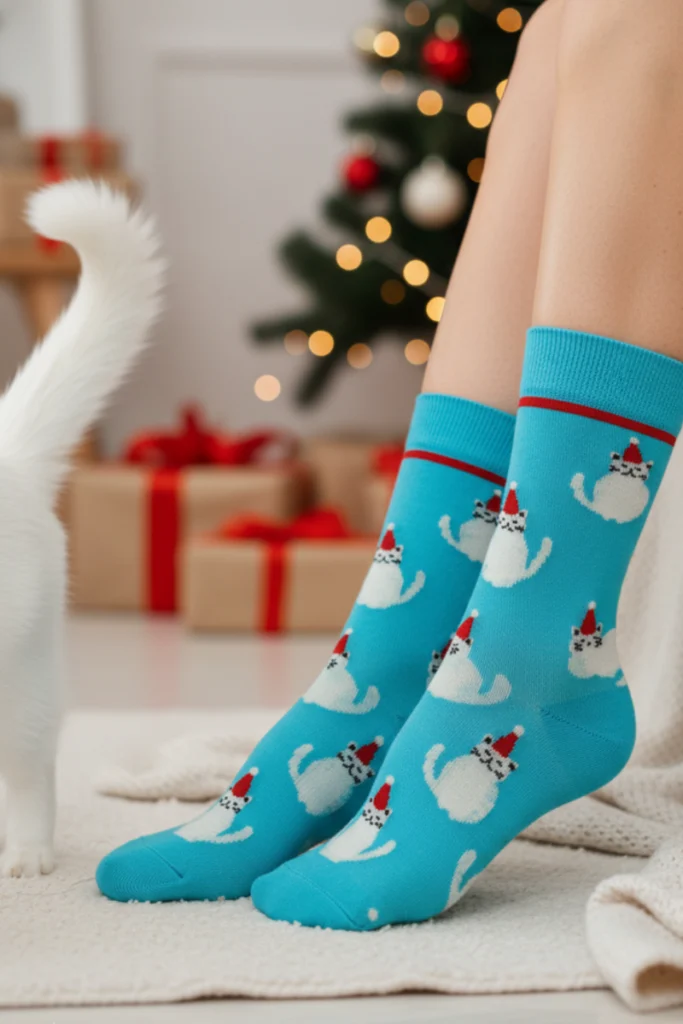
    Person wearing turquoise merino wool socks with festive cat pattern beside a white cat and Christmas tree.
    Durable merino socks

    Choosing Wool Socks for Every Activity

    The best wool sock for hiking is not the best wool sock for the office. Thickness, height, cushioning, and blend all matter depending on what you’re doing. Here’s how to match your wool socks to your activities.

    Hiking and Trail Walking

    For hiking, merino wool in medium or heavy weight is the undisputed champion, and there’s a reason every serious outdoor brand has adopted it. You want socks with reinforced heels and toes (these areas take the most punishment on the trail), cushioned soles that absorb impact on rocky terrain, and a snug fit around the arch that prevents the sock from bunching inside your boot. Bunching leads to hot spots, and hot spots lead to blisters, the number one complaint on any multi-day hike. The moisture-wicking properties of merino keep your feet dry even during strenuous climbs, and the temperature regulation means your feet stay comfortable whether you’re ascending a sun-baked ridge or descending into a cool, shaded valley. Crew or mid-calf length is essential for hiking boots, as it prevents the boot collar from rubbing directly against your skin.

    A pro tip from our customers who hike regularly: bring a dry pair of merino socks for the evening at camp. Changing into fresh, dry wool socks after a long day on the trail is one of the simplest luxuries in outdoor life, and your feet will recover significantly faster overnight.

    Everyday Winter Wear

    For commuting, working, and general cold-weather daily life, a medium-weight merino blend in crew or mid-calf length is ideal. These socks are thin enough to fit comfortably inside your regular shoes and boots, no need to size up your footwear, while providing dramatically more warmth than cotton. The key word here is “blend”: a composition of 60-70% merino with 30-40% nylon and elastane gives you merino’s warmth and moisture management with added durability and stretch. Pure merino is wonderful but can wear through faster in high-friction areas; the nylon reinforcement solves that. Choose darker colors (navy, charcoal, black) for work and bolder patterns or cable knits for weekends and casual wear. Our warm sock collection for women and men’s sock selection include a range of merino blends perfect for Estonian winters.

    Running and Athletic Training

    Lightweight merino running socks have quietly revolutionized athletic footwear over the past decade. Early adopters in the ultrarunning community discovered that merino outperformed synthetics on long distances, fewer blisters, less odor, better temperature management over hours of continuous effort. Now even mainstream running brands have merino options. For athletic use, look for thin, lightweight merino (not the thick hiking weight) with reinforced high-impact zones at the heel and ball of the foot, a compression band around the arch for support, and flat or seamless toe seams that eliminate friction points. Ankle or quarter length is standard for running; crew length works well for cross-training and gym work where you want slightly more coverage. You can find athletic options in our athletic sock collection.

    Skiing and Winter Sports

    Ski socks have a specific set of demands that differ from general warm socks. They need to be thin enough to fit precisely inside ski boots, a loose, bulky sock inside a ski boot creates pressure points and reduces your control over the ski. At the same time, they need strategic cushioning at the shin (where the boot tongue presses), the ankle (where buckles create pressure), and the sole (for impact absorption). The rest of the sock should be relatively thin for a precise fit. Merino wool is ideal here because it provides warmth without bulk, and its moisture management prevents the clammy, cold feeling that ruins a day on the slopes. Look for knee-high length that extends above the top of your ski boot, with flat seams throughout.

    Lounging at Home

    This is where you can abandon all practical considerations and just go for maximum coziness. Thick cable-knit wool socks, fluffy angora blends, cashmere-infused slipper socks, these are the socks you reach for on a rainy Sunday or a dark December evening. They’re not optimized for performance or durability; they’re optimized for that feeling of pure comfort when you sink into the couch with a warm drink. If you’re buying wool socks as a gift, this category almost always gets the best reaction. There’s something deeply satisfying about giving someone a pair of socks that makes them go “oh, these are SO soft” the moment they touch them. Browse our full wool collection for cozy home options.

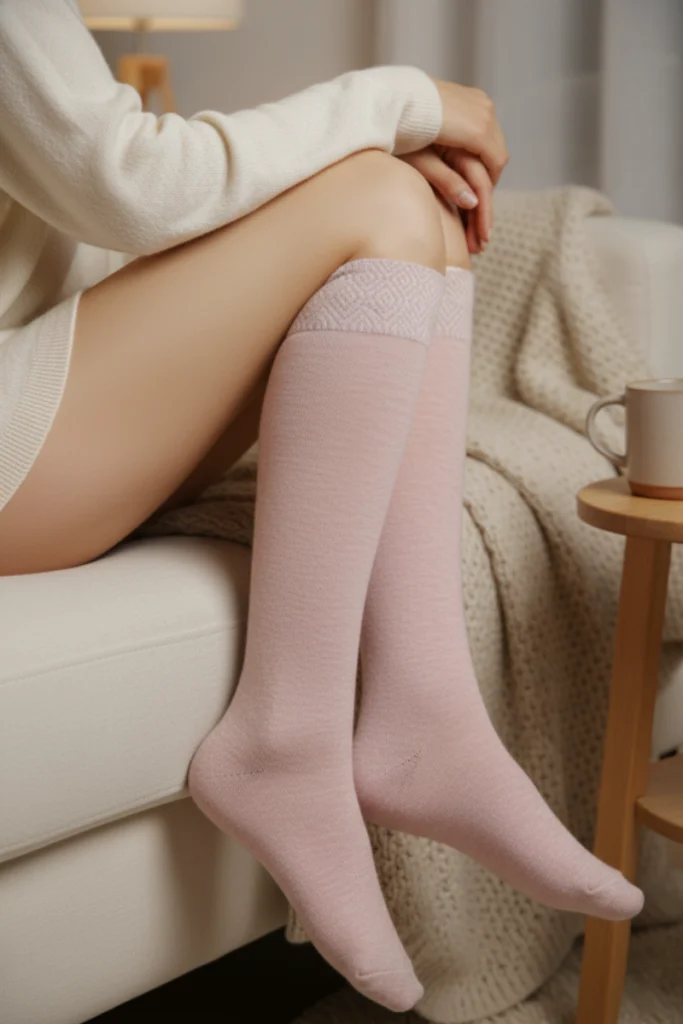
    Person sitting on a sofa wearing soft pink knee-high wool socks in a cozy living room.

    How to Care for Wool Socks (So They Last for Years)

    Proper care is the difference between wool socks that last one season and wool socks that last five years. The good news: caring for wool socks is simpler than most people think. The bad news: the dryer is their mortal enemy, and this is a hill we’re willing to die on.

    Washing

    Turn your wool socks inside out before tossing them in the machine. Use cold or lukewarm water, never hot, as heat causes wool fibers to felt and shrink irreversibly. A gentle or wool-specific cycle works perfectly, and most quality wool socks handle machine washing without any issues (always check the care label to be sure, but gone are the days when all wool required hand washing). Use a mild detergent, ideally one formulated for wool or delicates. Avoid bleach entirely, it destroys wool fibers. And skip the fabric softener, which coats the fibers and actually reduces their natural moisture-wicking ability. You’re paying for wool’s natural performance; don’t clog it up with chemicals.

    Drying

    This is the critical step. Never, ever put wool socks in the dryer. The combination of heat and tumbling causes wool to shrink and damages the fiber structure in a way that can’t be undone. Instead, gently reshape your socks after washing and lay them flat on a drying rack or towel, away from direct sunlight or heat sources. Most wool socks dry overnight at room temperature. If you’re in a hurry, placing them near (not on) a radiator speeds things up, but keep some distance, direct heat is the enemy.

    Storage

    Store wool socks in a cool, dry drawer. Fold them gently or lay them flat rather than balling them up, stuffing one sock inside the other stretches the elastic and deforms the cuff over time. If you’re storing them for the season (putting away your heavy winter socks in spring, for example), tuck a cedar block or lavender sachet into the drawer. Moths are attracted to natural animal fibers, and nothing ruins your autumn like discovering your favorite merino socks have become a moth nursery. Cedar and lavender are natural moth deterrents that also keep your sock drawer smelling pleasant. For more detailed care instructions, check our size chart and care guide.

    Wool vs. Cotton: An Honest Comparison

    We sell both wool and cotton socks at Sokisahtel, so we have no interest in unfairly bashing cotton, it has its place. But when customers ask us to honestly compare the two, here’s what we tell them.

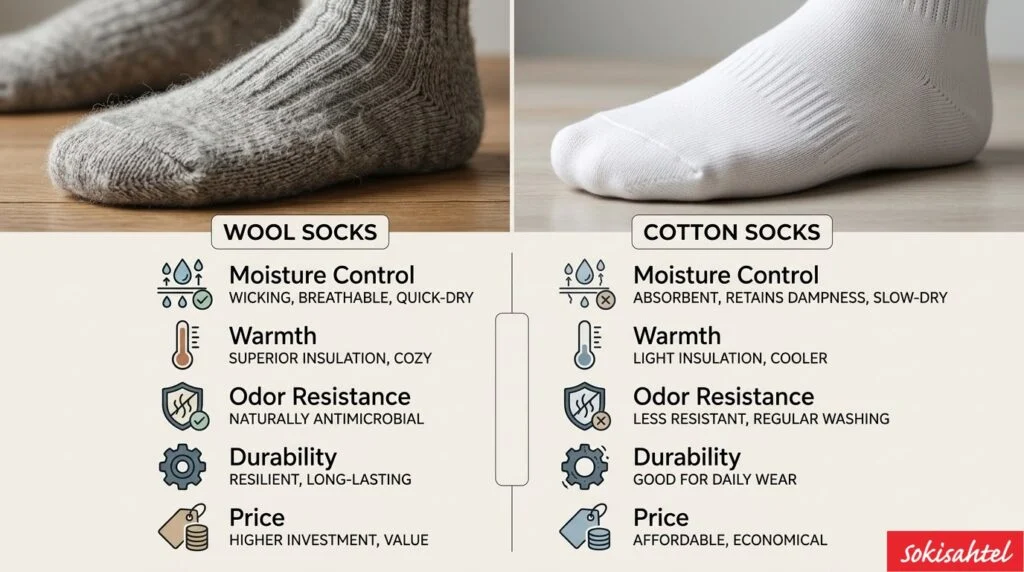
    Moisture: Cotton absorbs water and holds it against your skin, creating a damp environment that leads to cold feet, blisters, and odor. Wool absorbs moisture too, but then actively moves it away from your skin and releases it into the air. Your feet stay dry in wool; they don’t in cotton.

    Warmth: Cotton provides minimal insulation even when dry, and virtually none when wet. Wool insulates even when damp, a property that’s genuinely lifesaving in outdoor situations and extremely practical in everyday winter wear.

    Odor: Cotton socks develop noticeable odor after a single day of wear, sometimes sooner. Wool’s natural antibacterial lanolin means you can wear the same pair for two or three days with no detectable smell. This isn’t marketing, it’s chemistry.

    Durability: Wool fibers bend 20,000+ times before breaking; cotton manages about 3,000. Over months of wear, this translates directly into socks that keep their shape and cushioning versus socks that thin out and develop holes.

    Price: Cotton wins on upfront cost, no question. A pair of cotton socks might cost €3-5, while quality merino starts at €8-15. But when you factor in how much longer wool lasts and how many fewer pairs you need to buy over time, the cost per wear often favors wool. And the comfort difference is not even close.

    Our honest recommendation? Keep cotton socks for hot summer days when you need something ultra-light and disposable. For everything else, winter, hiking, travel, work, sports, wool is the better investment. Browse our cotton socks for summer and our wool collection for the rest of the year.

    Infographic comparing wool socks and cotton socks, showing wool socks offer better moisture control, warmth, odor resistance, and durability, while cotton socks are more affordable.

    Frequently Asked Questions

    Are wool socks good for summer?

    Yes, and this surprises almost everyone who asks. Lightweight merino wool socks are genuinely excellent for summer wear. The natural breathability and moisture-wicking properties keep your feet cooler and drier than cotton in warm weather. The key is choosing thin, lightweight merino, not the thick hiking socks designed for winter. A fine-gauge merino sock in summer feels cool, dry, and almost silky against the skin. We have customers who switched to merino year-round and report that their feet sweat less in summer than they did in cotton.

    Do wool socks make your feet itch?

    Traditional wool with thick, coarse fibers (above 25 microns) can absolutely cause itching, this is what gives wool its scratchy reputation. Modern merino wool socks use fibers so fine (15-24 microns) that they bend against your skin rather than poking it like little needles. The sensation is completely different: soft, smooth, and comfortable even for people who normally can’t tolerate wool. If you’ve avoided wool socks because of itchiness, merino specifically will change your experience entirely. And if even merino feels too much, alpaca wool is the most hypoallergenic natural option available.

    How long do wool socks last?

    With proper care (cold wash, air dry, no dryer), quality wool socks typically last 2-5 years of regular wear. The exact lifespan depends on the blend (pure merino wears faster than merino-nylon blends), the activity (hiking puts more stress on socks than office wear), and how often you rotate your pairs. Having 5-7 pairs in rotation for daily wear extends each pair’s life significantly because the fibers have time to recover between wears.

    Can you wear wool socks if you’re allergic to wool?

    Most people who believe they’re allergic to wool are actually sensitive to the coarse fibers in traditional wool, it’s a mechanical irritation, not a true allergy. Fine merino rarely causes these reactions. For people with confirmed wool sensitivity, alpaca wool is the best alternative: it’s naturally hypoallergenic because it contains no lanolin (the substance some people react to in sheep’s wool). That said, if you have a diagnosed wool allergy, consult your doctor before trying any animal fiber product. Our bamboo viscose socks are also an excellent non-wool option that shares many of wool’s benefits.

    Are wool socks worth the price?

    We’re obviously biased, but we genuinely believe so, and our customers’ repeat purchases back this up. While wool socks cost more upfront than cotton (typically €8-15 vs €3-5 per pair), they last 3-5x longer, perform dramatically better in cold and wet conditions, and provide a level of comfort that makes getting dressed in the morning just a little bit nicer. When you calculate cost per wear, wool often comes out cheaper. And there’s no price tag on the feeling of warm, dry feet on a -20°C Estonian morning.

    How many pairs of wool socks do I need?

    For daily winter wear, 5-7 pairs allow you to rotate through a full week with time for washing and drying. For hiking specifically, 2-3 good pairs handle most trips, merino’s odor resistance means you can genuinely wear a pair for 2-3 days between washes on the trail. If you want to dip a toe in (pun intended) without committing to a full drawer of wool, start with 2 pairs: one for daily wear and one for outdoor activities. You’ll know within a week whether you’re converting.

    Our Wool Sock Picks from Sokisahtel

    We carry wool socks from Estonian and European producers who share our standards for quality and natural materials. Our wool sock collection includes merino, alpaca, angora, and cashmere options for women, men, and children, from everyday merino blends that handle the daily commute to luxuriously soft angora pairs that make perfect gifts.

    Not sure which wool type is right for you? Our customer service team is available Monday through Friday, 9 a.m. to 5 p.m., and they’ve helped thousands of customers find their perfect wool socks. Reach out at info@sokisahtel.net or call +372 5551 0994, we’re always happy to talk socks.

    → Browse our wool sock collection

  • Types of Socks: A Complete Guide to Every Sock Length and Style

    Types of Socks: A Complete Guide to Every Sock Length and Style

    Walk into any sock store, or scroll through any sock website, and the sheer variety can be overwhelming. Ankle socks, crew socks, no-shows, knee-highs, compression socks, dress socks, athletic socks, wool socks, bamboo socks, novelty socks with cats on them. How did something as simple as a foot covering become so complicated? The answer is that different socks solve different problems, and understanding what’s available helps you stop buying the wrong socks and start buying ones that actually make your day better.
    At Sokisahtel, we carry over 1,500 different sock models, from everyday cotton basics to Italian-made Pierre Mantoux hosiery, so we’ve spent more than a decade helping people navigate this surprisingly complex world. This guide organizes every type of sock by length, style, material, and purpose, so you can quickly find exactly what you need.

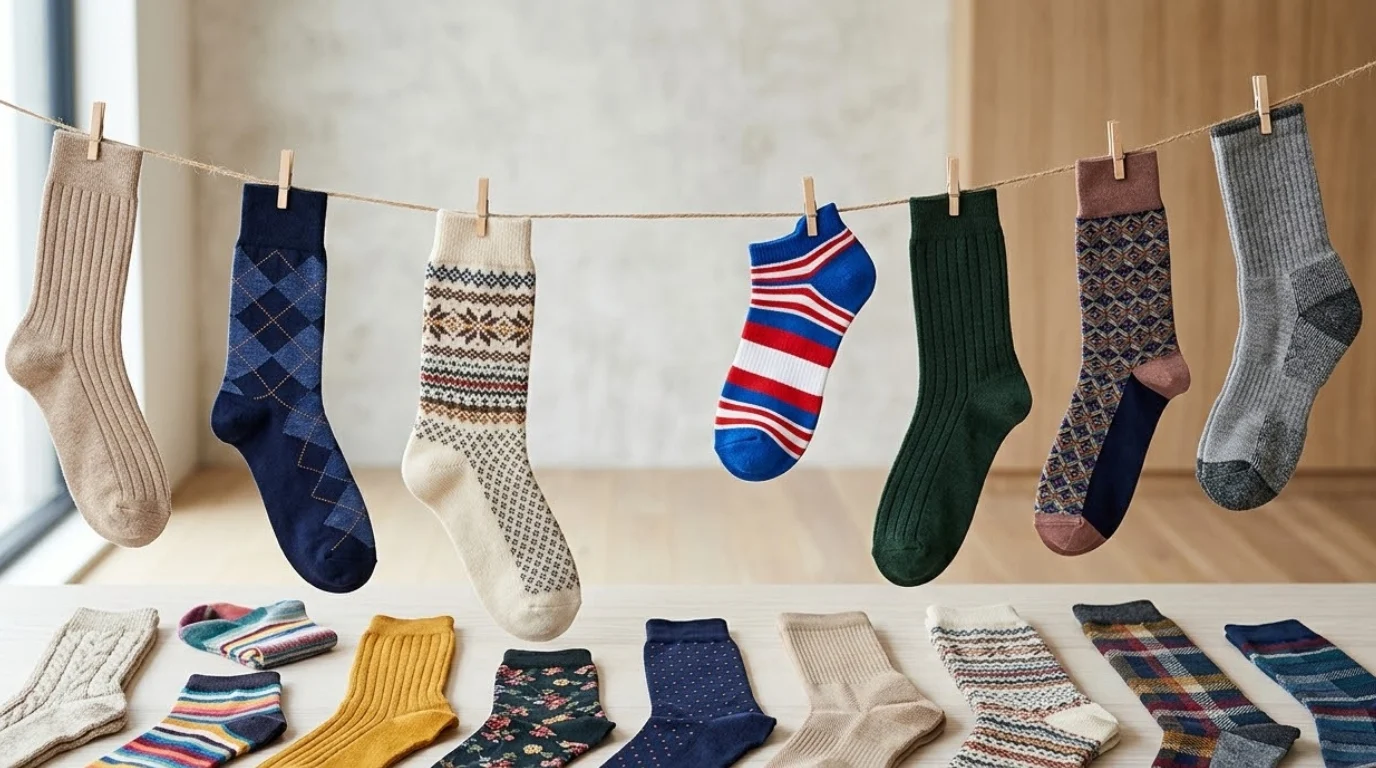
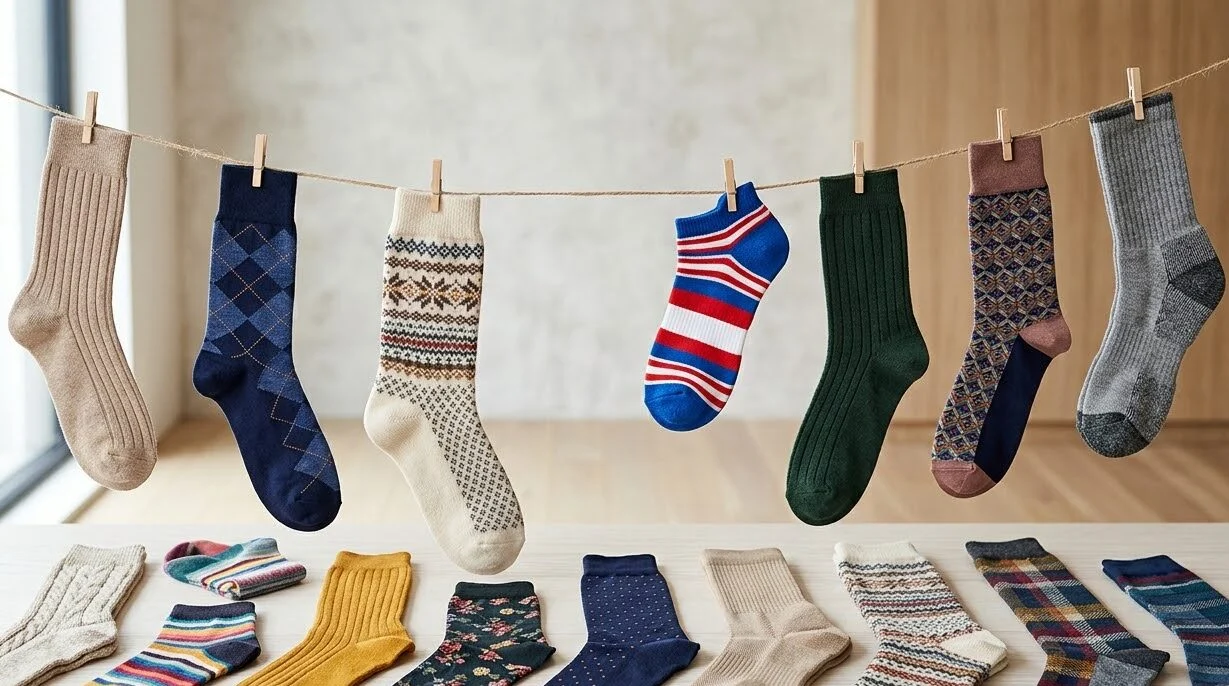
    Various socks in different lengths and styles, including ankle, crew and athletic socks, arranged side by side on a clothesline and table.

    Sock Types by Length

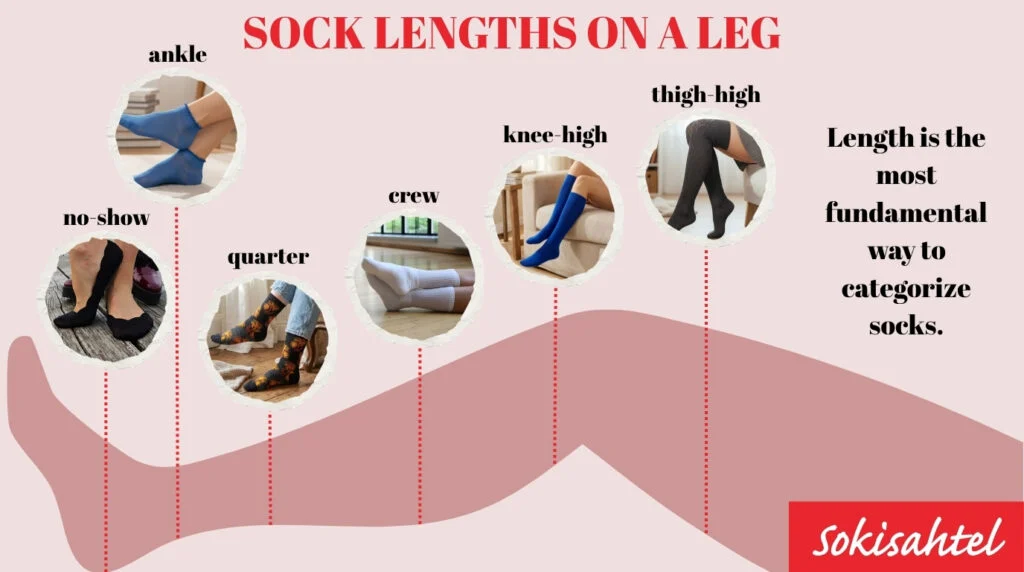
    Length is the most fundamental way to categorize socks, and it’s usually the first thing you should decide when shopping. The right length depends on your shoes, the occasion, and the season. Here’s every standard sock length, from shortest to tallest.

    No-Show Socks (Invisible Socks / Liner Socks)

    No-show socks sit below the shoe line, completely invisible when you’re wearing low-cut shoes. They exist for one reason: to give you the barefoot look while still providing a barrier between your foot and the shoe interior. That barrier matters more than you might think, going truly barefoot in shoes leads to blisters, excessive sweating, odor buildup inside the shoe, and premature deterioration of the shoe lining.

    The biggest issue with cheap no-shows is slipping. If you’ve ever spent a day constantly reaching down to pull your sock back onto your heel, you know the frustration. Look for no-shows with silicone grip strips on the heel, this one feature makes the difference between a sock that stays put and one that ends up bunched under your arch by noon. At Sokisahtel, our footies and no-show collection focuses on exactly this: socks that actually stay invisible all day.

    Best paired with: Loafers, boat shoes, low-top sneakers, slip-ons, ballet flats, and any outfit where you want the sockless aesthetic, popular in summer with cropped trousers, shorts, or skirts.

    Ankle Socks

    Ankle socks hit just above the ankle bone, roughly 2-4 cm above the shoe line. They’re the world’s most popular everyday sock length, the default choice you’ll find in multipacks at every clothing store. There’s a reason for their ubiquity: ankle socks are casual, comfortable, unobtrusive, and work with the vast majority of everyday shoes and outfits. They provide enough coverage to prevent shoe rubbing around the ankle while leaving most of your lower leg exposed for a relaxed look.

    For athletic use, ankle socks are a solid choice for gym workouts, running, and everyday sports. However, they offer minimal protection above the ankle, so they’re not ideal for hiking boots or any shoe with a tall collar that might rub against bare skin. If you spend your days in sneakers, trainers, or casual shoes, ankle socks will cover 90% of your needs. Browse our women’s sock selection or men’s socks for everyday ankle options.

    Quarter Socks

    Quarter socks extend about 5-8 cm above the ankle bone, roughly a quarter of the way up your calf. This extra height might sound minor, but it solves a real problem that ankle socks can’t: protection of the Achilles tendon and lower ankle area from shoe rubbing. Quarter socks have become the preferred length for many athletic brands precisely because they prevent the blisters and irritation that form when a shoe collar repeatedly rubs against bare skin during movement.

    Quarter socks are often confused with ankle socks when shopping online, so check the stated height carefully. They’re an excellent middle ground, more protective than ankle socks, less visible than crew socks, and they’re steadily growing in popularity for both athletic and casual wear. If you run, play tennis, or do any sport that involves lateral movement, quarter socks are worth trying over standard ankle socks.

    Crew Socks

    Crew socks reach mid-calf, approximately 15-20 cm above the ankle bone. When someone says “socks” without any further description, this is what most people picture. Crew socks are the most versatile length in existence, they work for casual wear, office settings, sports, hiking, and cold weather. They sit high enough that your bare leg never shows when you sit down and your trouser leg rides up, which makes them the minimum acceptable length for business and formal settings.

    Crew socks have also become a deliberate fashion statement in recent years. The “pulled-up crew sock with sneakers” look, once considered a dad faux pas, is now a core element of streetwear and athleisure. White crew socks with chunky sneakers and shorts? That’s a look people are choosing on purpose, and it works. For cold weather, crew socks provide meaningful warmth by covering the lower calf where cold air would otherwise hit bare skin. If you could only own one sock length for the rest of your life, crew would be the rational choice.

    Knee-High Socks

    Knee-high socks extend from the foot to just below the kneecap, roughly 35-40 cm above the ankle. They serve both practical and fashion purposes. On the practical side, knee-highs provide maximum warmth and coverage, essential for tall boots where you don’t want your sock to end mid-calf and create a visible line or uncomfortable pressure point. On the fashion side, knee-highs paired with skirts and dresses create a distinctive, eye-catching look that ranges from preppy schoolgirl to sophisticated European, depending on the styling.

    Knee-highs are also the standard length for football, rugby, and other field sports. In the medical world, knee-high compression stockings are among the most commonly prescribed garments for circulation issues, travel, and post-surgical recovery. Our knee-high collection includes everything from sheer, elegant options to warm wool knee-highs for winter.

    Thigh-High and Over-the-Knee Socks

    These extend above the knee to mid-thigh or higher, and they’re primarily a fashion item. Thigh-highs make a bold visual statement, they’ve been a recurring trend in autumn/winter collections for years, paired with short skirts, dresses, or worn peeking out from tall boots. Cable-knit thigh-highs in wool or cotton have a cozy, romantic quality; sleek, fitted versions in fine knit lean more dramatic and evening-appropriate.

    The practical challenge with thigh-highs is keeping them up. Look for versions with silicone grip bands at the top, or pair them with a garter belt for a secure fit. At Sokisahtel, we carry hold-ups and thigh-highs from Pierre Mantoux and other European brands known for quality construction and elegant design.

    Sock length comparison diagram showing how no-show, ankle, quarter, crew, knee-high and thigh-high socks sit on the leg side by side.

    Sock Types by Purpose and Style

    Athletic Socks

    Athletic socks are engineered for performance rather than looks. They typically feature moisture-wicking materials (synthetic blends, merino wool, or bamboo), cushioned soles that absorb impact, arch support bands that keep the sock in place during movement, and reinforced heels and toes for durability in high-friction areas. Good athletic socks also have mesh ventilation panels on the top of the foot for breathability and flat or seamless toe closures that prevent irritation during repetitive motion.

    The right athletic sock varies by sport: runners generally prefer ankle or quarter length with lightweight cushioning; hikers need mid-calf or crew length with medium-to-heavy cushioning in merino wool; gym-goers can choose based on preference, though quarter length with arch support is a reliable all-rounder. We stock athletic socks for women and men in a range of materials and weights.

    Dress Socks

    Dress socks are thin, smooth, and made from fine-gauge materials like combed cotton, merino wool, silk blends, or high-quality viscose. Their purpose is to look sleek and professional inside dress shoes while providing enough coverage that no bare skin shows when you sit down. Mid-calf length is the standard for dress socks, anything shorter risks the embarrassing flash of leg between trouser hem and shoe top.

    The traditional rule for dress socks is to match them to your trousers (not your shoes), creating a seamless visual line from pant to foot. Dark navy, charcoal, and black cover most business situations. However, subtly patterned dress socks, small dots, thin stripes, muted checks, have become an accepted way to express personality within professional dress codes. At Sokisahtel, our men’s dress sock selection in sizes 40-42 and 43-45 is made from combed cotton for that fine, elegant finish that suits demand.

    Compression Socks

    Compression socks apply graduated pressure, tightest at the ankle, decreasing up the calf, to improve blood circulation in your lower legs. They were originally a medical product for patients with circulatory issues, but they’ve been widely adopted by travelers (preventing DVT on long flights), nurses and healthcare workers (reducing leg fatigue during 12-hour shifts), pregnant women (managing swelling), and athletes (speeding post-exercise recovery).

    Compression levels range from mild (8-15 mmHg) for everyday comfort to extra firm (30-40 mmHg) for medical conditions. For most everyday users, travelers, office workers, people who stand a lot, moderate compression (15-20 mmHg) is the sweet spot. Our compression collection includes both medical-grade and everyday options.

    Novelty and Patterned Socks

    Socks have become one of the most accessible ways to express personality through clothing. Novelty socks feature everything from cats and dogs to food, professions, hobbies, holidays, and humorous messages. At Sokisahtel, “message” socks with slogans have become some of our bestsellers, people love wearing a small, hidden piece of personality that they can reveal with a flash of ankle or a crossed leg.

    Patterned socks (polka dots, stripes, argyle, geometric designs) occupy the middle ground between novelty and dress, they add visual interest without being as loud as a sock with a pizza slice on it. They make excellent gifts because they’re personal, inexpensive, and universally useful. Our polka dot and message sock collection is a great starting point, and our animal sock collection (cats, dogs, and more) is perpetually popular.

    Toe Socks

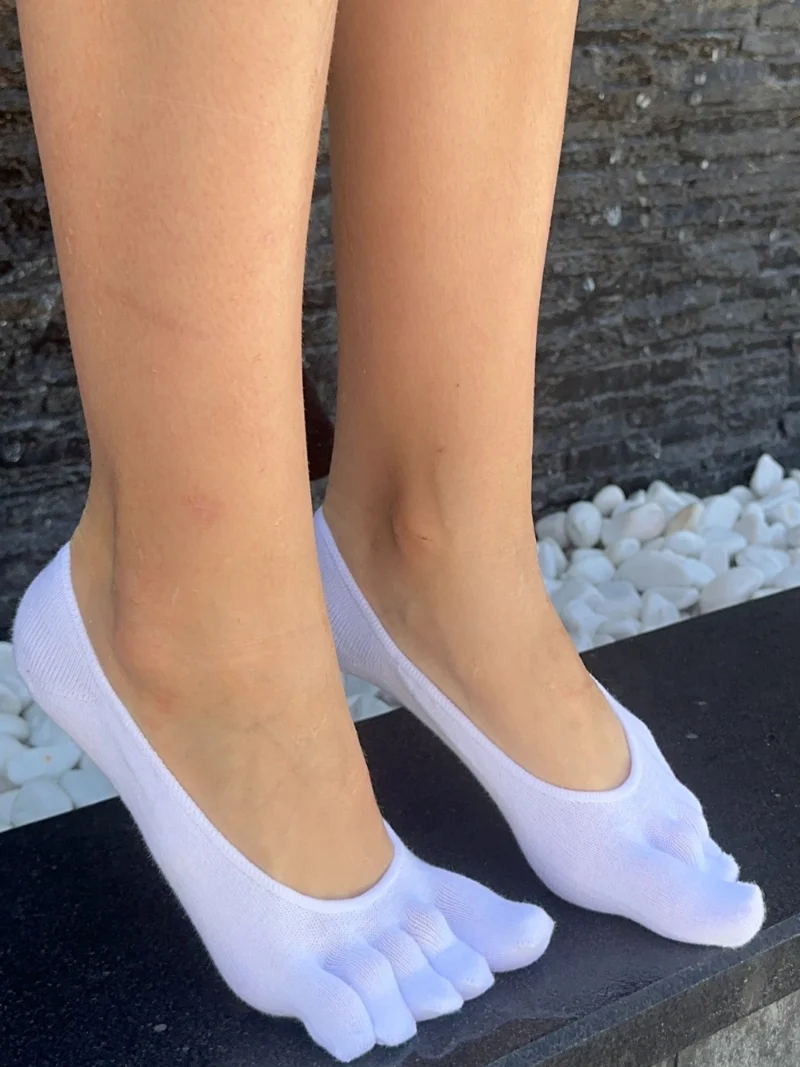
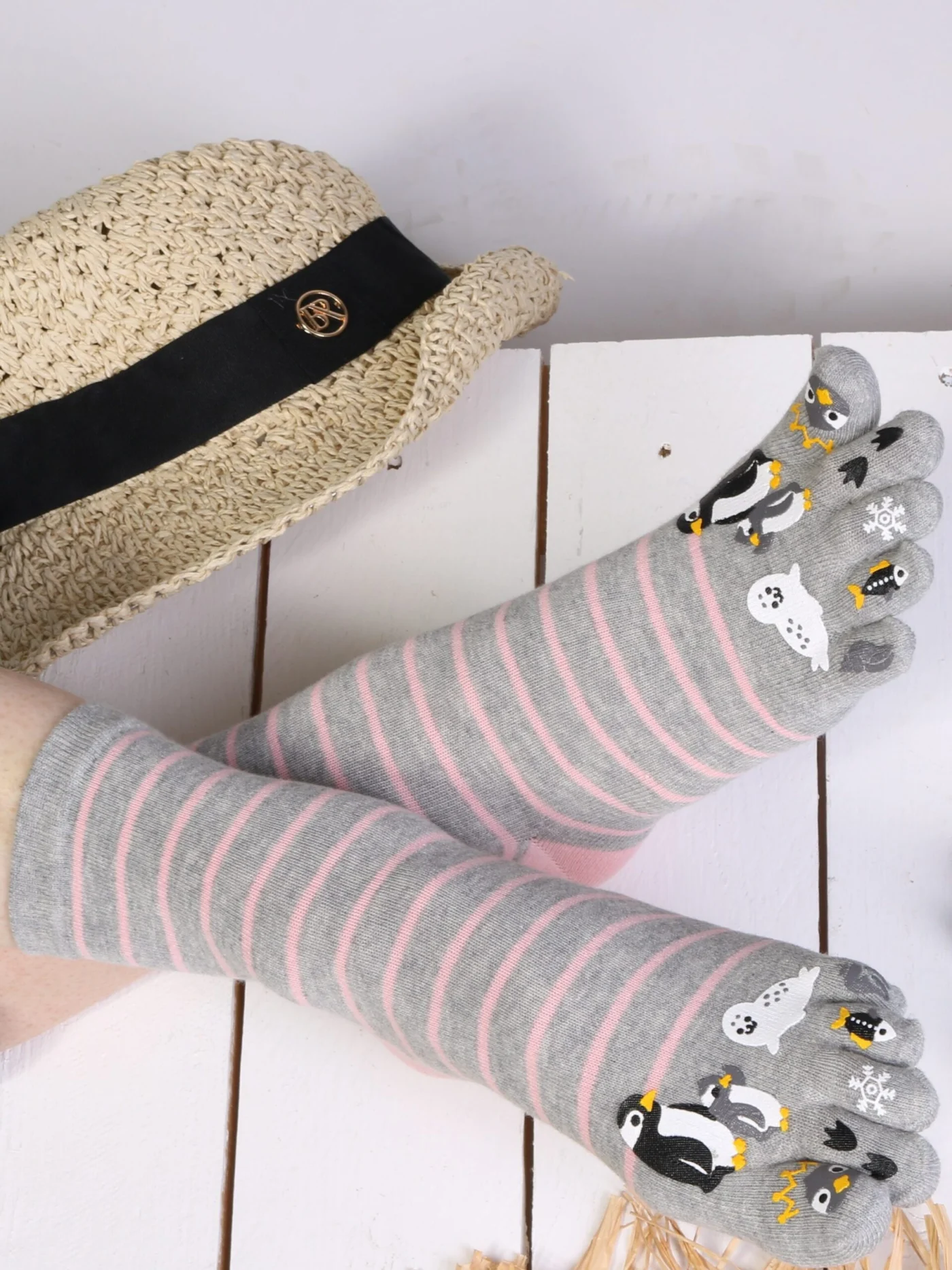
    Toe socks have individual compartments for each toe, similar to glove fingers. They look unusual, but they serve a genuine purpose: by separating the toes, they reduce friction between them, prevent blisters in the toe area, and improve balance and toe splay. Runners and hikers who are prone to inter-toe blisters swear by them. They also work well with flip-flops and toe-post sandals. The initial sensation of fabric between your toes takes a few wears to get used to, but most converts find they prefer the feeling once they’ve adjusted. We carry toe socks for those who want to try this distinctly different sock experience.
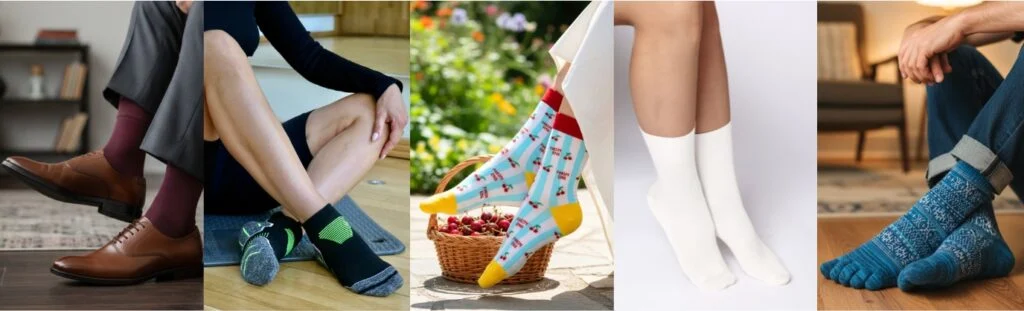
    Grid of different sock types, including classic dress socks, sports socks, patterned socks, compression socks and toe socks, shown in everyday wear.
    Different sock styles. From left to right: dress socks, athletic socks, patterned socks, medical socks, toe socks.

    Sock Types by Material

    The material of a sock determines its performance characteristics more than any other factor. Here’s what each material actually does well (and where it falls short).

    Cotton

    Cotton is the world’s most common sock material. It’s soft, breathable, affordable, and available everywhere. For casual, everyday wear in mild to warm weather, cotton socks do the job. However, cotton has one significant weakness: it absorbs moisture and holds it. This means cotton socks get damp from foot sweat and stay damp, leading to a clammy feeling, faster odor development, and increased blister risk during physical activity. Cotton is best for light, everyday use in warm, dry conditions, and it’s best avoided for sports, hiking, cold weather, or any situation where your feet will sweat significantly. Our cotton sock collection offers quality everyday options in various colors and patterns.

    Merino Wool

    Merino wool is the premium sock material for a reason. It regulates temperature (warm in winter, cool in summer), wicks moisture away from your skin, resists odor naturally thanks to its lanolin content, and lasts far longer than cotton. Modern merino socks are nothing like the scratchy wool socks of decades past, the fibers are so fine that they feel soft and smooth against skin. Merino is the best all-around choice for cold weather, hiking, travel, and any situation where comfort and performance matter. The only downside is price, merino socks typically cost 2-3x more than cotton, though they last proportionally longer. For a deep dive into wool socks, read our complete guide to wool socks, and browse our wool sock collection.

    Bamboo Viscose

    Bamboo viscose socks have surged in popularity over the past decade, and for good reason. The fabric is naturally moisture-wicking, breathable, antibacterial, and has a silky-smooth texture that many people prefer to cotton. Bamboo socks tend to feel cooler than other materials, making them an excellent warm-weather choice. They’re also a strong option for people with sensitive skin or mild allergies, as bamboo viscose is gentle and hypoallergenic. Environmentally, bamboo is a rapidly renewable resource that grows without pesticides, adding a sustainability angle that matters to many shoppers. We stock a curated selection of bamboo viscose socks that deliver on these benefits.

    Synthetic Blends (Polyester, Nylon, Elastane)

    Synthetic fibers are almost always blended with natural fibers rather than used alone in socks. Nylon adds durability and stretch, polyester contributes moisture-wicking speed, and elastane (Lycra/spandex) provides the elastic recovery that keeps socks snug. A typical quality sock might be 70% cotton or merino with 25% nylon and 5% elastane, the natural fiber provides the comfort and next-to-skin feel, while the synthetics ensure the sock holds its shape, dries quickly, and lasts through hundreds of washes. Pure synthetic socks (100% polyester, for example) can feel plastic-y and tend to develop odor quickly, which is why most quality brands use blends rather than pure synthetics.

    Silk and Cashmere

    At the luxury end, silk and cashmere socks exist for people who want the absolute finest next-to-skin experience. Silk is incredibly lightweight, has natural temperature-regulating properties, and feels almost impossibly smooth. Cashmere is the softest wool available, feather-light and extraordinarily warm. Both materials are delicate and expensive, best reserved for special occasions, gifts, or quiet indulgence at home rather than everyday wear. They represent the “treat yourself” category of socks.

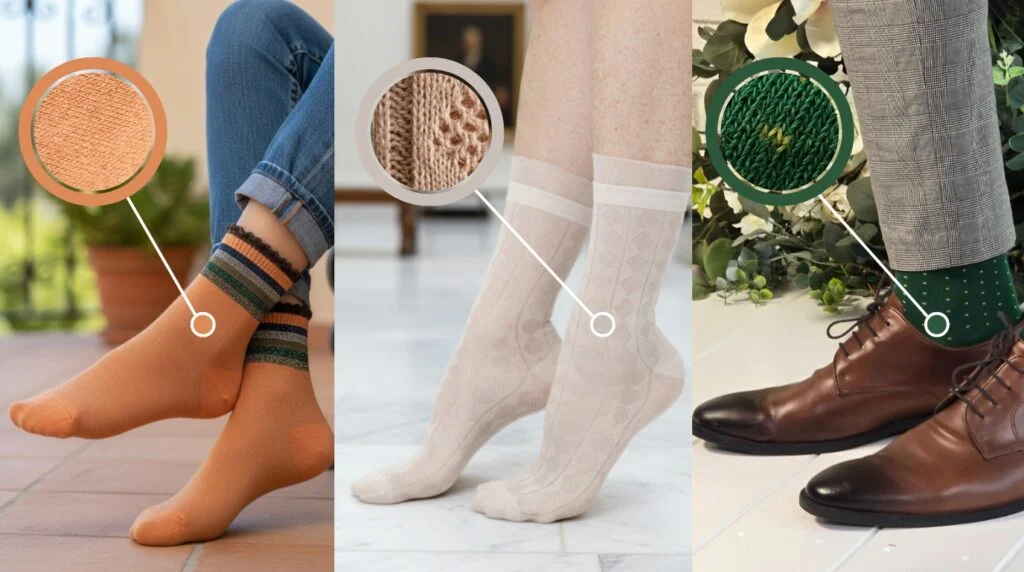
    Material comparison of socks with close-up texture shots, showing visible differences in knit and weave between cotton, merino wool, bamboo viscose and synthetic-blend styles.

    How to Choose the Right Socks: A Practical Framework

    With all these options, choosing socks comes down to three questions asked in order. First: what shoes are you wearing? Low-cut shoes call for no-shows or ankle socks, mid-height shoes work with quarter or crew, and tall boots need crew or knee-highs. Second: what’s the occasion? Business and formal settings require at least crew-length dress socks where no bare skin shows; casual settings let you wear whatever length looks and feels good. Third: what’s the activity and weather? Cold weather and outdoor activities call for wool in longer lengths; hot weather favors lighter materials (cotton, bamboo) in shorter lengths; sports need moisture-wicking materials with support features.

    If all else fails, a drawer stocked with these three types handles about 90% of life’s sock situations: quality ankle socks in cotton or bamboo for everyday casual wear, mid-calf merino wool socks for cold weather and outdoor activities, and a few pairs of fine-gauge crew or mid-calf socks in dark colors for business or dressy occasions. Everything else, novelty socks, athletic socks, compression socks, cozy home socks, fills specific niches as needed.

    Frequently Asked Questions

    What are the most common types of socks?

    The most common sock types by length are ankle socks, crew socks, and no-show socks. By material, cotton socks are the most widely sold, followed by merino wool and synthetic blends. By purpose, everyday casual socks dominate the market, followed by athletic socks, dress socks, and compression socks. At Sokisahtel, ankle and crew length cotton socks are our highest-volume sellers, but merino wool socks have the highest customer satisfaction and reorder rate.

    What type of socks should I wear with dress shoes?

    Fine-gauge crew or mid-calf socks in combed cotton, merino wool, or silk blend. The cardinal rule: no bare skin should show between your trouser hem and your shoe when you sit down. Match sock color to your trousers (not your shoes) for the most polished look. Dark navy, charcoal, and black cover almost every formal situation.

    What socks are best for sweaty feet?

    Merino wool is the best overall material for sweaty feet due to its superior moisture wicking and natural antibacterial properties. Bamboo viscose is a close second, especially in warm weather. Avoid cotton, which absorbs moisture and holds it against your skin. For a deeper look at this topic, read our guide to the best socks for sweaty feet.

    Are expensive socks worth it?

    In our experience, yes, up to a point. Quality socks in the €8-15 range (merino blends, quality bamboo, well-made cotton) typically offer dramatically better comfort, fit, durability, and performance than €2-3 budget socks. Beyond €15-20, you’re paying for luxury materials (cashmere, silk) or designer branding, which is a personal choice rather than a practical necessity. The sweet spot for most people is a well-made merino or bamboo sock in the €8-12 range, noticeably better than cheap cotton, without the premium price of luxury.

    How many pairs of socks should I own?

    A practical minimum is 10-14 pairs for everyday rotation (allowing a full week plus washing time), plus 2-3 pairs each for specific activities (athletic, dress, cold weather). Many people get by with fewer by doing laundry more frequently, and wool socks can stretch intervals thanks to their odor resistance. At Sokisahtel, our gift sets are a convenient way to stock up on multiple pairs at a better price per pair.

    Find Your Perfect Socks at Sokisahtel

    With over 1,500 models from Estonian and European producers, Sokisahtel has been helping people find their perfect socks since 2010. Whether you need everyday basics, performance athletic socks, luxury wool for winter, or the perfect patterned pair for a gift, our collection covers every type discussed in this guide, and then some. We ship worldwide with free delivery on orders over €40.

    → Shop women’s socks | Shop men’s socks | Browse all collections

  • Best Merino Wool Socks of 2026: Tested & Compared

    Best Merino Wool Socks of 2026: Tested & Compared

    If you’ve ever wondered why merino wool socks cost more than a regular cotton pair, put them on once in freezing weather, or during a summer hike, and you’ll understand immediately. Merino wool is nature’s performance fabric: it regulates temperature, wicks moisture, resists odor, and feels impossibly soft against the skin. But not all merino socks are created equal.

    We’ve spent years curating European-made merino wool socks at Sokisahtel, testing dozens of brands and blends. This guide breaks down what makes a great merino sock, which styles work best for different activities, and how to choose the right pair for your needs.

    Why Merino Wool Socks Are Worth the Investment

    Regular wool has a reputation for being itchy and bulky. Merino wool is different. The fibers are much finer, typically 17,22 microns compared to 30+ microns for standard wool, which makes them soft enough to wear against bare skin without irritation.

    Here’s what sets merino apart from cotton, synthetic, and regular wool socks:

    Temperature regulation. Merino fibers trap tiny pockets of air that insulate in cold weather, but the fabric also breathes exceptionally well in heat. This is why merino hiking socks work in both winter and summer conditions.

    Moisture management. Merino wool can absorb up to 30% of its weight in moisture before feeling wet. Cotton, by comparison, becomes heavy and clammy after absorbing just 7%. This makes merino ideal for active use, long days on your feet, or anyone prone to sweaty feet.

    Natural odor resistance. The lanolin in merino fibers has antibacterial properties. You can wear merino socks for multiple days, yes, really, before they develop any noticeable smell. This makes them a traveler’s secret weapon.

    Durability. A quality merino sock outlasts cotton socks significantly. Merino fibers can bend 20,000+ times before breaking, compared to about 3,000 for cotton.

    What to Look for When Buying Merino Wool Socks

    Merino Content: Does 100% Merino Matter?

    You’ll see merino socks ranging from 30% to 100% merino content. Higher isn’t always better. Here’s why:

    100% merino wool socks offer maximum warmth, softness, and odor resistance. They’re ideal for cold-weather wear and situations where natural performance matters most. However, they tend to wear out faster without reinforcement from synthetic fibers.

    Merino blends (50,80% merino) are often the sweet spot for everyday and athletic use. A blend with nylon or polyamide adds durability at the heel and toe, the areas that take the most abuse. Many of the best hiking socks use a 60,70% merino blend for exactly this reason.

    Low merino content (under 40%) often means the sock uses merino as a marketing buzzword rather than a functional material. You won’t get the full temperature regulation and odor resistance benefits at this level.

    Weight and Thickness

    Merino socks come in different weights, and choosing the right one depends entirely on the activity:

    Ultralight/liner weight, Thin, breathable socks for running shoes, warm-weather hiking, or wearing inside dress shoes. These keep feet cool and dry without adding bulk.

    Lightweight, The most versatile option. Suitable for everyday wear, casual hiking, and most office environments. Enough cushioning for comfort without making your shoes feel tight.

    Midweight, Added cushioning on the sole and heel. Best for cooler weather hiking, winter everyday wear, and boots.

    Heavyweight/expedition, Maximum warmth and padding. Designed for extreme cold, mountaineering, or heavy-duty winter boots.

    Fit and Construction

    A few details separate a good merino sock from a great one:

    Seamless toe closure prevents the ridge that causes blisters during long hikes. If you’re buying hiking socks, this is non-negotiable.

    Arch support, a slightly tighter knit around the midfoot keeps the sock from sliding and bunching.

    Reinforced heel and toe, look for socks that add nylon or polyamide in the high-wear areas. This dramatically extends the sock’s lifespan.

    Best Merino Wool Socks by Category

    Best for Everyday Wear

    For daily use at the office, around town, or casual outings, you want a lightweight merino sock that looks good enough for any shoe and feels comfortable for 10+ hours. Look for merino content of 60,80%, flat-knit construction that fits smoothly in dress shoes, and subtle patterns or solid colors.

    A good everyday merino sock should last 2,3 years of regular washing and wearing. European-made socks from countries like Estonia, Finland, and Italy tend to have tighter quality control and use higher-grade merino than mass-market alternatives.

    Best Merino Wool Hiking Socks

    Hiking socks need more cushioning, better moisture management, and tougher construction than everyday socks. The best merino wool hiking socks share several characteristics: midweight to heavyweight construction, reinforced heel and toe zones, seamless toe closure, and a snug but not restrictive fit through the arch.

    For summer hiking, choose a lighter weight with mesh ventilation zones. For winter trails, go heavier with extra cushioning on the sole. Many hikers swear by crew-length socks that extend above the boot line to prevent chafing.

    Best Merino Wool Dress Socks

    Merino dress socks solve a common problem: feet that overheat and sweat in conventional dress shoes. A fine-gauge merino dress sock looks identical to a cotton or synthetic dress sock but performs dramatically better throughout a long day.

    Look for ultralight to lightweight construction, fine-gauge knitting that appears smooth and polished, and a merino content of 70%+ for the best temperature regulation in formal footwear.

    Best Merino Wool Socks for Women

    Women’s merino socks deserve specific attention because many brands simply resize men’s patterns. The best women’s merino socks account for narrower heels, different arch profiles, and the variety of shoe styles women wear, from boots to ballet flats to heels.

    Compression merino socks are increasingly popular among women, combining the temperature regulation of merino with graduated compression that reduces leg fatigue during long days of standing or travel.

    How to Care for Merino Wool Socks

    Merino socks last significantly longer with proper care:

    Washing: Machine wash cold or warm (never hot) on a gentle cycle. Turn socks inside out first. Use a mild detergent, avoid fabric softeners, which coat the fibers and reduce their natural performance properties.

    Drying: Air dry flat when possible. If you must use a dryer, use the lowest heat setting. High heat causes merino to felt and shrink.

    Storage: Store clean and dry. Moths love wool, so consider cedar blocks or lavender sachets in your sock drawer.

    Frequency: Thanks to merino’s odor resistance, you don’t need to wash after every wear. For lightly worn socks, every 2,3 wears is fine, this actually extends the sock’s lifespan considerably.

    Merino Wool Socks: Frequently Asked Questions

    Are merino wool socks good for summer?
    Yes, this surprises many people. Merino’s temperature regulation works both ways. In warm weather, the fibers wick moisture and allow airflow, keeping feet cooler than cotton socks. Choose ultralight or lightweight merino socks for summer.

    Do merino wool socks shrink?
    They can if washed in hot water or dried on high heat. Always wash cold or warm and air dry. Merino blends with nylon are more resistant to shrinking than 100% merino.

    How long do merino wool socks last?
    With proper care, quality merino socks last 1,3 years depending on usage. Socks with nylon-reinforced heels and toes last the longest.

    Are merino socks worth the price?
    Consider cost per wear. A €15 merino sock that lasts 2 years and requires fewer washes costs less per day than a €3 cotton sock that wears out in 3 months. Add the comfort and performance benefits, and it’s one of the best clothing investments you can make.

    What’s the difference between merino and regular wool socks?
    Merino fibers are much finer (17,22 microns vs 30+ microns), making them softer and less itchy. Merino also has superior moisture wicking and temperature regulation compared to standard wool.

    How to Pick the Right Merino Wool Socks for You

    The best merino wool socks depend entirely on what you’re using them for. For everyday wear, a lightweight 60,80% merino blend offers the ideal balance of comfort, durability, and performance. For hiking, go midweight with reinforced construction. For dress occasions, choose fine-gauge ultralight merino that looks as polished as it performs.

    Whatever you choose, once you switch to merino wool socks, going back to cotton feels like a downgrade. Your feet will notice the difference immediately, and after a few months, your sock drawer will likely be entirely merino.

    Browse our merino and wool sock collection to find your perfect pair. Free shipping on orders over €40.

  • How to Choose Tights for Girls?

    How to Choose Tights for Girls?

    In kindergarten and the early school years, festive events seem to pop up like mushrooms after the rain. One week it’s the Christmas party, then a school ceremony, next comes a birthday or a Mother’s Day concert. Parents know exactly what that means, it’s time once again to find a dress, shoes, hair clips, and of course, tights for girls.

    Surprisingly often, it’s the tights that decide whether a child feels dressed up and confident or would rather just pull on a tracksuit. Girls’ tights are a small detail that brings the whole outfit together. They’re practical, comfortable, and warm, yet also neat and elegant. The right pair of tights can instantly turn any dress into a party outfit.

    White girls' tights with adorable kittens

    Why Tights Are the Cornerstone of a Child’s Festive Outfit

    Parties at kindergarten and school aren’t just about sitting still and singing songs. More often than not, there’s dancing, running, sitting on the floor, and even a bit of climbing involved. That’s why the outfit needs to be both comfortable and durable.

    Tights give children the freedom to move and keep their legs warm, even when the celebration lasts for hours or takes place in a chilly hall. At the same time, they look neat and elegant, pairing perfectly with a dress, skirt, or dance costume.

    How to Choose the Right Tights for Girls

    1. Comfort Comes First

    If the waistband digs in, the seams twist, or the fabric itches, the whole celebration can be ruined. Little kids won’t just ignore it, they’ll start tugging, fidgeting, and before long, the tights will end up in the trash. Choose a soft, stretchy, and breathable material that doesn’t pinch, roll, or slide down.

    2. The Right Size

    Children’s tights that are “just barely the right size” will turn into a source of complaints within an hour. On the other hand, ones that are too big bunch up around the ankles and look sloppy. If you’re choosing between two sizes, go for the larger one, especially if several events are coming up or your child is growing quickly.

    3. Material Depends on the Season

    In autumn and winter, choose thicker tights that keep your child warm while still allowing the skin to breathe. In spring or warmer weather, lighter tights are better, they offer more freedom of movement. Wool tights are also a great choice under rubber boots when it’s muddy outside or the walk to preschool involves a few puddles.

    4. Color and Pattern

    Festive doesn’t have to mean boring. Classic colors like white, gray, beige, and navy blue are always a safe choice for school ceremonies or concerts, but for kindergarten parties, you can add a bit of fun, think tiny dots, hearts, or a lace trim. The key is that the pattern matches the dress and, most importantly, that your child likes it!

    5. Durability and Quality

    Cheap tights often tear after just one wear. If you know there are several events coming up, and your little one isn’t exactly the type to sit still like an angel, it’s worth choosing thicker, more tightly woven tights that can handle a bit more action.

    STEFFI blue girls’ tights
    STEFFI blue girls’ tights
    ELY sparkling girls’ tights
    ELY sparkling girls’ tights
    TITA white girls’ tights
    TITA white girls’ tights

    Examples: Which Girls’ Tights Suit Which Occasion

    Kindergarten Christmas Party

    Warm, soft, and slightly festive tights are the best choice, think light colors or a subtle shimmer. Wool or cotton materials are ideal, as children often sit on the floor while waiting for their turn to perform.

    School Ceremony

    Classic, understated colors like white, gray, navy, or black work best here. If the weather is cool, choose thicker tights, as school halls can get quite chilly in autumn. You can also add subtle patterns that complement the outfit.

    White tights are always a festive and elegant choice for girls!
    White tights are always a festive and elegant choice for girls!

    Birthday or Family Celebration

    For a birthday, a touch of playfulness works best, a fun pattern, colorful stripes, or a lace detail can all be great choices. If the party takes place in a playroom or outdoors, go for a durable and stretchy pair.

    Polka-dot tights for kids
    Polka-dot tights for kids

    Small but Important Tips

    • A spare pair is a must. Every parent knows the moment, a hole appears in the tights right before the performance.
    • Rain boots and tights can get along just fine. If the weather is chilly or rainy, let your child wear boots on the way to kindergarten and switch to dress shoes once you arrive, the tights will stay clean, and your child will stay warm.
    • Wash on a gentle cycle. Avoid fabric softener, as it can damage the elasticity. Also, always wash tights at a low temperature.

    A Comfortable Child = A Calm Parent

    Festive clothing doesn’t have to mean stiffness or discomfort. When a child can move, sit, and dance freely, they’re happy, and that makes the whole day easier for everyone. 

    Elegance starts with the small details. Sometimes, just the right pair of tights can make the entire day go smoothly.

    In addition to tights for young girls, Sokisahtel also has a separate category for baby tights. You can find them here!

  • How to Organize Your Socks the Right Way

    How to Organize Your Socks the Right Way

    Organizing your sock drawer might seem like a trivial task, but it can significantly improve your daily routine and reduce stress. A well-organized sock drawer saves time, prevents frustration, and maintains the quality of your socks. In this article, we’ll explore 10 professional tips to help you declutter and arrange your socks efficiently.

Organizing socks

Key Takeaways

  • Begin by completely emptying your sock drawer to take stock of what you have.
  • Sort socks by type and color, and discard any that are worn out or without a mate.
  • Utilize drawer organizers or the file folding method to maximize space and visibility.
  • Regularly declutter your sock drawer to maintain organization and make room for new purchases.
  • Consider sustainability by recycling old socks or repurposing them for household uses.

1. Decluttering the Sock Drawer

Decluttering your sock drawer is a simple yet effective way to streamline your morning routine and keep your belongings organized. Start by emptying out your entire drawer and laying all pairs on a flat surface. This allows you to see everything you have and makes the next steps easier.

  • Match up all pairs: Ensure each sock has its mate. Any lone socks should be set aside; these can be repurposed or discarded if no match is found after a complete search.
  • Assess and eliminate: Look at the condition of each pair. Discard any that are worn out or no longer fit. Also, consider how many pairs you realistically need and reduce duplicates.
  • Organize by frequency of use: Place the socks you wear most often at the front of the drawer or in an easily accessible spot.
Suit socks for men

By decluttering, you not only make it easier to find what you need but also reduce the clutter that can build up over time.

This process not only frees up space but also saves you time in the future, making your daily routine more efficient.

2. Arranging the Socks

Once you’ve decluttered your sock drawer, the next step is to arrange your socks efficiently. Start by categorizing your socks into different groups such as dress, athletic, cozy indoor, playful, and no-show socks. You might also consider organizing them by length or color.

Sock organizing illustration

Place Socks Into an Organizer

Choose a compartmentalized drawer or bin that allows you to keep your socks organized by category. This setup will help maintain order in your drawer and make it easier to find what you need quickly.

Ensure each type of sock has its designated spot in the drawer, which will simplify your routine and keep your socks in good condition.

For those with extensive collections, consider using vertical stacking or laying socks on their sides to maximize space and visibility.

3. Sort by Type

Once you’ve ensured all socks are paired and in good condition, it’s time to sort by type. Categorize them into groups such as sports, dress, trainer, and bed socks. Additionally, sort these categories by color. This not only makes it easier to find what you need but also helps in identifying excess in certain categories. For instance, having multiple pairs of black socks might be practical if you wear them to work regularly, but you might want to reconsider the necessity of numerous holiday-themed socks.

Organizing socks by type and color simplifies your daily selection and keeps your drawer manageable.

Here’s a suggested way to arrange your socks within the drawer:

  • Daily wear socks at the front
  • Less frequently worn socks at the back
  • Group similar types together, like gym socks in one section and work socks in another

This method ensures everything has its designated space, making your sock drawer both functional and tidy.

Women footies

4. Designate a Sock Drawer

When organizing clothes, it’s highly beneficial to designate a drawer solely for socks if possible. This not only simplifies finding what you need but also maximizes space efficiency. Socks tend to fit better and stay more organized when stored with similar items. Consider using drawer organizers or dividers to maintain order and prevent socks from becoming jumbled.

By dedicating a specific drawer to your socks, you ensure that they are not only well-organized but also easily accessible.

For optimal organization, you might choose a compartmentalized drawer or bin that allows you to sort socks by category. This setup helps maintain an orderly drawer over the long term.

5. Use Store-Bought Drawer Organizers

Gift boxes with different socks

Investing in effective bedroom organizers is key to maintaining a neat, tidy, and easily accessible sock drawer. Store-bought organizers come in various shapes and sizes, including cloth containers, honeycomb-style organizers, and mesh pocket inserts. Measure your drawer before purchasing to ensure you’re making the best use of space. Here are some options and their typical costs:

  • 2 Pack Socks Underwear Drawer Organizer: $11.69 at Walmart

Despite best efforts, these organizers don’t always fit perfectly, leaving you with dead space. To maximize space, consider using adjustable dividers that can be tailored not just to the dimensions of the drawer, but also to different sock types, such as thick winter socks and slim trainer socks. Set the dividers lengthwise and place your most used categories upfront to maintain an orderly system.

6. Use the File Folding Method

The file folding method is a space-saving and practical way to organize your socks in a drawer. By folding your socks into a simple rectangle and placing them vertically in the drawer, you can easily see and access each pair. This method not only keeps your socks neatly organized but also minimizes the need to rummage through the drawer, keeping it tidy for longer.

Steps to File Fold Your Socks

  1. Lay each sock flat.
  2. Fold the socks in half lengthwise.
  3. Place them next to each other vertically, like files in a cabinet.

Bold Tip: Aim to create a simple rectangle when the socks are folded to ensure they all have the same folded size.

This technique is not only efficient but also aligns with methods used for organizing other clothing items, such as t-shirts, making your entire wardrobe easier to manage.

Designed torn socks

7. Clearing Clutter, Purging Tips for Socks

Purging your sock drawer is a straightforward task that can yield satisfying results. Grab the 6 purging bags you prepared earlier and decide whether to bring your sock drawer to a more comfortable spot like your living room, or tackle the task directly at your dresser. This activity is perfect for multitasking; you can even do it while watching your favorite TV show.

  • Purge: Remove socks that are worn-out, mismatched, or no longer needed and place them in the purging bags.
  • Put Everything Away: Once you’ve sorted through and decided which socks to keep, neatly organize them back into your drawer. For tips on various ways to fold socks, refer to the section on folding techniques.

With your purging complete, you might find you have extra time or energy. Use this to revisit previous decluttering tasks or simply relax and enjoy the progress you’ve made.

8. Tips for Folding and Organizing Socks

Organizing your socks efficiently can transform your drawer from a chaotic jumble into a neatly arranged space. Here are some practical tips to help you fold and organize your socks effectively:

  • Consistently return socks to their designated spots after each wash to maintain order.
  • Routinely review and declutter your sock drawer to avoid overcrowding.
  • Choose a folding method that suits your space and preference. The popular methods include folding socks into rectangles or rolling them into tight cylinders.
  • Use drawer organizers to separate different types of socks, making them easy to find.
  • Label compartments if necessary, to further ease the process of finding the right pair.
  • Rotate socks seasonally to keep your drawer relevant and manageable.

Remember, the key to keeping socks organized is consistency in how you handle them post-laundry.

9. Products to Organize Socks

When it comes to keeping your sock drawer in check, there are numerous products available that can help streamline the process and maintain order. Investing in store-bought drawer organizers is a practical approach to ensure your socks are neatly arranged and easy to find. These organizers come in various forms, such as cloth containers, honeycomb-style organizers, and mesh pocket inserts. It’s important to measure your drawer beforehand to choose the right size and style that maximizes space efficiency.

For those looking to save money, creating your own dividers using old boxes is a viable alternative. By adjusting the depth of the boxes, you can tailor them specifically for socks, making this a cost-effective and customizable solution.

Keep everyday pairs within easy reach by using specialized organizers that allow you to separate frequently worn socks from the rest.

Here are some popular options:

  • 2 Pack Socks Underwear Drawer Organizer – $11.69 at Walmart
  • Honeycomb-style drawer organizer from The Container Store

These products not only help keep your sock drawers organized but also limit the number of socks you keep to what fits in the organizer.

10. Easy Decluttering Steps

Decluttering your sock drawer doesn’t have to be a daunting task. Follow these simple steps to create a more organized and functional space:

  1. Start by emptying your drawer completely. This will give you a clear view of what you have and what needs to go.
  2. Sort socks into categories: keep, donate, and discard. Be ruthless with socks that are worn out or no longer needed.
  3. Pair up all remaining socks. This ensures that each sock has its mate and makes them easier to organize.
  4. Use dividers or small boxes to separate different types of socks. This will keep your drawer tidy and make it easier to find what you need.
  5. Finally, maintain your newly organized drawer by revisiting it monthly to ensure it stays decluttered and functional.
Suit-Up dress socks for men

By following these steps, you’ll not only declutter your sock drawer but also make your daily routine more efficient.

Conclusion

By implementing these 10 professional sock organization tips, you can transform your cluttered sock drawer into a model of efficiency and style. From sorting by type and color to utilizing space-saving folding techniques, each tip is designed to help you quickly locate the perfect pair of socks while maintaining a tidy drawer. Remember, a well-organized sock drawer not only saves you time but also extends the life of your socks by preventing them from becoming stretched or damaged. Embrace these strategies and enjoy the simplicity and satisfaction of a well-organized space.

Frequently asked questions

Frequently Asked Questions

How do you declutter a sock drawer?

Start by gathering all your socks, including those in the laundry, and match them up. Discard any that don’t have a mate or are damaged. Consider how many pairs you need and reduce duplicates. Recycle or repurpose unwanted socks.

What is the best way to sort socks in a drawer?

Sort socks by type (e.g., sports, dress, casual) and color. This categorization helps you find what you need quickly and keeps your drawer organized.

How can I prevent losing socks?

Use a mesh laundry bag for your socks when washing them. This keeps pairs together and prevents them from getting lost in the laundry process.
What are the benefits of using drawer organizers for socks?

Drawer organizers help keep socks neatly separated, making it easier to find a matching pair and maintain an organized drawer.

Is it better to fold or roll socks for storage?

Rolling socks can save space and prevent them from stretching out. However, folding can be better for thicker socks to maintain their shape.

How often should I declutter my sock drawer?

It’s a good idea to declutter your sock drawer at least twice a year to remove any worn-out or unused socks and keep your collection manageable.

  • Why Toe Socks Are the Ultimate Comfort: Benefits and Styles Explained

    Why Toe Socks Are the Ultimate Comfort: Benefits and Styles Explained

    toe socks, characterized by their distinctive design that encases each toe separately, stand apart from regular socks. In both form and functionality. Unlike conventional, which envelop the foot in a single compartment, fingersocks offer individual pockets for each toe. Akin to the fingers in a glove. This design not only provides a unique aesthetic but also confers a multitude of benefits. Ranging from improved foot health to enhanced performance in physical activities.

    Benefits of Toe Socks

    Everyone definitely knows about socks; some love them and wear them, others do not care for them and avoid them. However, this can’t be said about digital socks. For many, they still remain a so-called “terra incognita”. The “unknown land” that the average person’s foot has not tread upon. Also, to many, they seem unusual and even strange due to the divisions for each toe. However, despite their unconventional shape, they have many positive properties that everyone should know about.
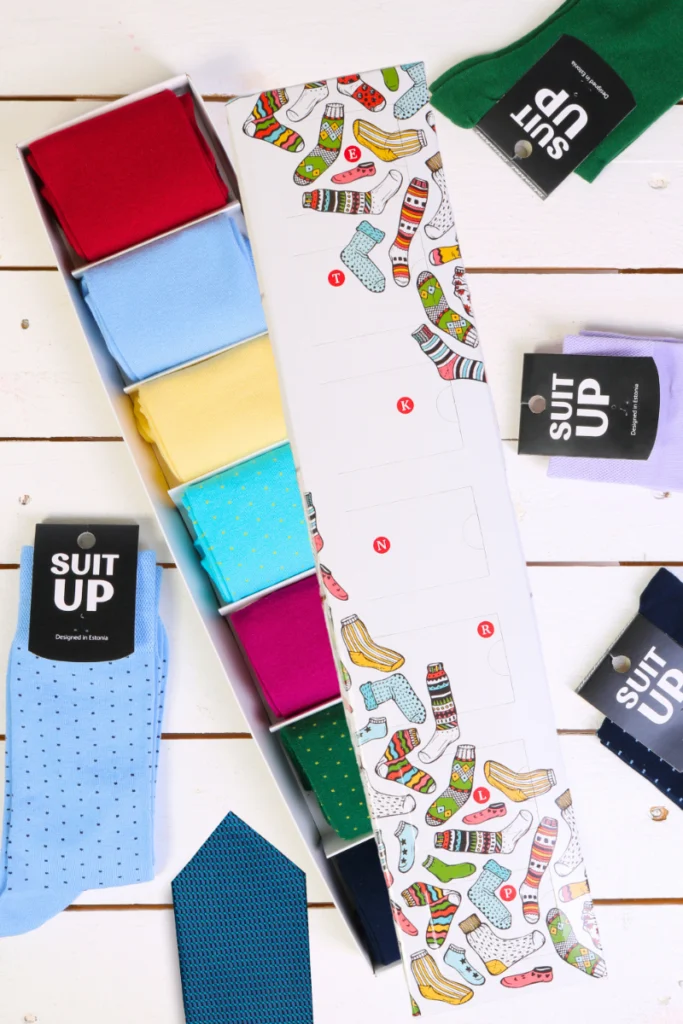
    Striped toe socks from Sokisahtel

    Enhanced Comfort and Reduced Friction

    By minimizing toe-to-toe contact, toe socks significantly reduce the risk of blisters and calluses. Particularly during extended periods of physical activity. This feature is invaluable for runners, hikers, and athletes who rely on their feet’s health and comfort for optimal performance.

    Moisture-Wicking and Odor Control

    Thanks to materials such as merino wool, bamboo, and synthetic blends, toe socks excel at wicking away moisture. This keeps the feet dry and comfortable, thereby reducing the risk of fungal infections. And eliminating odor,a boon for active individuals who demand both hygiene and comfort from their footwear.

    Improved Circulation and Toe Alignment

    The design of toe socks encourages natural toe splay, which can lead to better toe alignment and improved circulation. This aspect is particularly beneficial for individuals suffering from foot conditions like bunions or hammertoes. It offers them a chance for both comfort and therapeutic benefits.

    Warmth and Fashion

    Digital socks wrap each toe in warmth, making them exceptionally suitable for cold weather conditions. Additionally, the variety of colors and patterns available makes fingersocks a fashionable choice for those looking to make a statement with their feet.

    Toe Socks vs Regular Socks

    The primary distinction between glove socks and regular socks lies in the design. While regular socks offer a one-size-fits-all approach, fingersocks cater to each toe’s unique shape, providing a more personalized and snug fit. This design difference not only affects comfort but also impacts the sock’s functional benefits, such as moisture management and blister prevention.

    Toe Socks for Physical Activities

    Sport, even if we’re not talking about a professional level, is demanding not only of the person engaging in it but also of their equipment/clothing. Therefore, in sports, there are no trifles or unimportant details. Sometimes microseconds decide the result. This means that properly selected socks can significantly improve sports performance or, at the very least, provide the athlete with the necessary comfort.

    Running and Hiking

    For runners and hikers, the reduced friction and enhanced moisture-wicking capabilities of toe socks can prevent blisters and fungal infections, making long distances more manageable and enjoyable.

    Yoga

    In yoga, where foot grip and balance are paramount, toe socks offer the added advantage of improved toe spread and grip, aiding in stability during poses.

    Short toe socks

    Athletes

    Across various sports, athletes can benefit from the improved balance, moisture management, and reduced risk of foot ailments that glove socks provide, allowing for better focus on performance.

    Contribution to Foot Health

    Digital socks contribute significantly to foot health by promoting a more natural toe alignment, which can alleviate pain and discomfort associated with foot deformities. The separation between toes also allows for better air circulation around the foot, reducing moisture buildup and the risk of fungal infections.

    Unique design

    Materials in Toe Socks

    Common materials for toe socks include merino wool, known for its temperature-regulating properties; bamboo, celebrated for its softness and antibacterial qualities; and synthetic fibers like polyester and nylon, which offer durability and quick-drying capabilities. These materials are chosen for their ability to provide comfort, moisture-wicking, and odor control.

    Specific Designs for Activities

    Manufacturers have developed toe socks specifically designed for running, yoga, and hiking, with features such as extra cushioning in high-impact areas, non-slip grips for yoga, and thermal properties for cold-weather hiking. These specialized socks cater to the unique needs of each activity, offering targeted support and benefits.

    Toe Socks and Foot Conditions

    Toe socks can offer relief to those with certain foot conditions like bunions and hammertoes by providing a more natural foot position and reducing pressure on the affected areas. However, it’s essential for individuals with specific foot conditions to consult a healthcare provider to ensure glove socks are suitable for their particular needs.

    Fashionable Options

    In addition to their functional benefits, digital socks come in a wide range of fashionable options, from vibrant colors and patterns to themed designs. This variety allows wearers to express their personal style while enjoying the health and performance benefits of fingersocks.

    Toe socks with penguins
    Unique design
    Toe socks with adorable kittens

    In conclusion, toe socks offer a unique combination of health, performance, and fashion benefits that distinguish them from regular ones. Whether for sports, therapeutic reasons, or simply as a fashion statement, fingersocks have carved a niche in the footwear industry, providing benefits that cater to a wide range of needs and preferences.

    Tabi Socks: The Split Toe Alternative

    If you enjoy the feel of toe socks but prefer a simpler design, tabi socks are worth exploring. Originally from Japan, tabi socks feature a single split between the big toe and the remaining four toes, rather than individual compartments for each toe. This makes them easier to put on while still offering many of the alignment and grip benefits of full toe socks.

    Tabi socks are particularly popular among yoga practitioners and fans of Japanese sandals (geta and zori), where the split toe design is essential. They also work well as an everyday sock for people who find full toe separation too intense but still want better toe awareness and natural foot positioning. The tabi design encourages a more natural gait and can help with balance, making them a practical choice for both casual wear and active pursuits.

    Modern tabi socks come in a range of materials, from lightweight cotton for summer to cozy wool blends for winter. Whether you choose full toe socks or the split toe tabi style, both offer a step up from conventional socks when it comes to foot health and comfort.

    Ready to try toe socks or tabi socks for yourself? Browse our sock collection at Sokisahtel and find your perfect pair.

  • Back to school! How to choose the right tights for children?

    Back to school! How to choose the right tights for children?

    School will start again soon, and it’s a good time to start preparations. In addition to notebooks, textbooks, and pens, it is also wise to check the sock and tights drawer. To sort out the ones that are too small and replace them with new ones. We have a large and wide selection of tights, so we wrote down how to choose the right pantyhose for your kids. This way, finding the kind of tights you are looking for is easy.

    What to keep in mind when making a choice? Material, pattern, thickness.

    It would be best to start by thinking about what the pantyhose will be needed for. For example, do you need them for everyday wear, for festive events, or for protection against the cold in winter?

    caldo_black

    School uniform tights

    Each school has special colored tights for the school uniform, either dark blue, dark red, black or gray. Tights that are plain and not brightly colored are usually preferred. When choosing tights for school uniform, it is also important that the tights are durable and in the right size. Ask the school for exact instructions and make a choice in the e-store or in the store! Since school lasts from autumn to spring, it is worth investing in warmer material so that the child’s feet stay warm even in the freezing cold.

    Every day children’s tights

    Every day children’s tights are mostly made of cotton, either single-colored or with some fun patterns. However, the golden rule for cotton pantyhose is that the more pattern there is, the less they stretch. This is also worth taking into account when choosing the size for pantyhose. However, cotton tights are a good choice for everyday wear precisely because of their pleasant soft feel and durability. They don’t make your feet itch and don’t break easily.

    aston_boys
    sokisahtel_ricci

    Festive tights

    Often made of polyamide, thinner material than cotton. Polyamide tights are perfect for wearing under skirts and dresses, for example, at the beginning ceremony of the school year. Due to the sheer material, they are also a good choice in early autumn or late spring, when the weather is quite warm, but you don’t want to go out with bare legs yet. We have a selection of sheer festive pantyhose in plain white and creamy colors and also with various beautiful patterns.

    Merino wool tights and leggings

    However, merino wool tights and leggings are ideal for the winter season. Merino wool tights are often the first choice of parents to keep their children warm in the cold autumn and winter months. Merino wool is ideal for small children because it reacts to body temperature, absorbs moisture, and is allergy-free. The unique feature of merino wool is that it does not make your feet sweat even during the most active activities. This makes it an ideal choice for every kid who loves to play outside during winter.

    merino wool leggings

    How to choose the right size for a child?

    The sizes of children’s pantyhose are according to the child’s height and are indicated on the package in centimeters, similar to the sizing of clothes. However, if the child has longer legs slightly, it is worth buying bigger tights, so they stay on the leg more comfortably and do not tear or roll down. Women’s tights in sizes XS, S, and M are also perfect for taller girls. The package of women’s pantyhose also has a size chart, which makes it easy to choose the right size.

    As previously mentioned, it should be taken into account that patterned cotton tights stretch less than, for example, polyamide tights. Therefore, when choosing the size of tights, their material and thickness are worth considering.

    pantyhose for babies

    How to properly care for pantyhose ?

    As tights are delicate and children tend to put them through a lot, it is generally recommended to wash pantyhose by hand. The best temperature for this is up to 40 degrees. If you still want to wash the tights in the washing machine, use the gentlest wash function and choose the cold water program. When washing in a washing machine, you should also use a laundry bag for thinner tights, so they don’t get damaged.
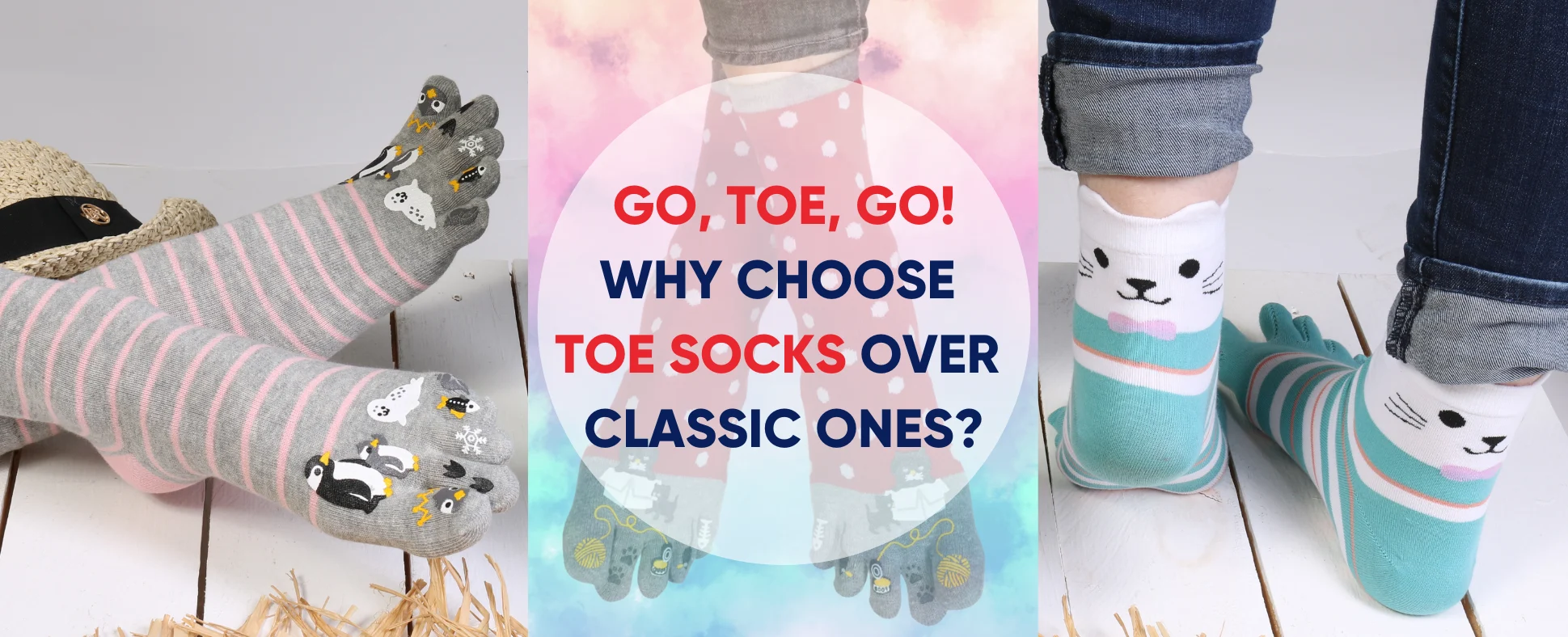
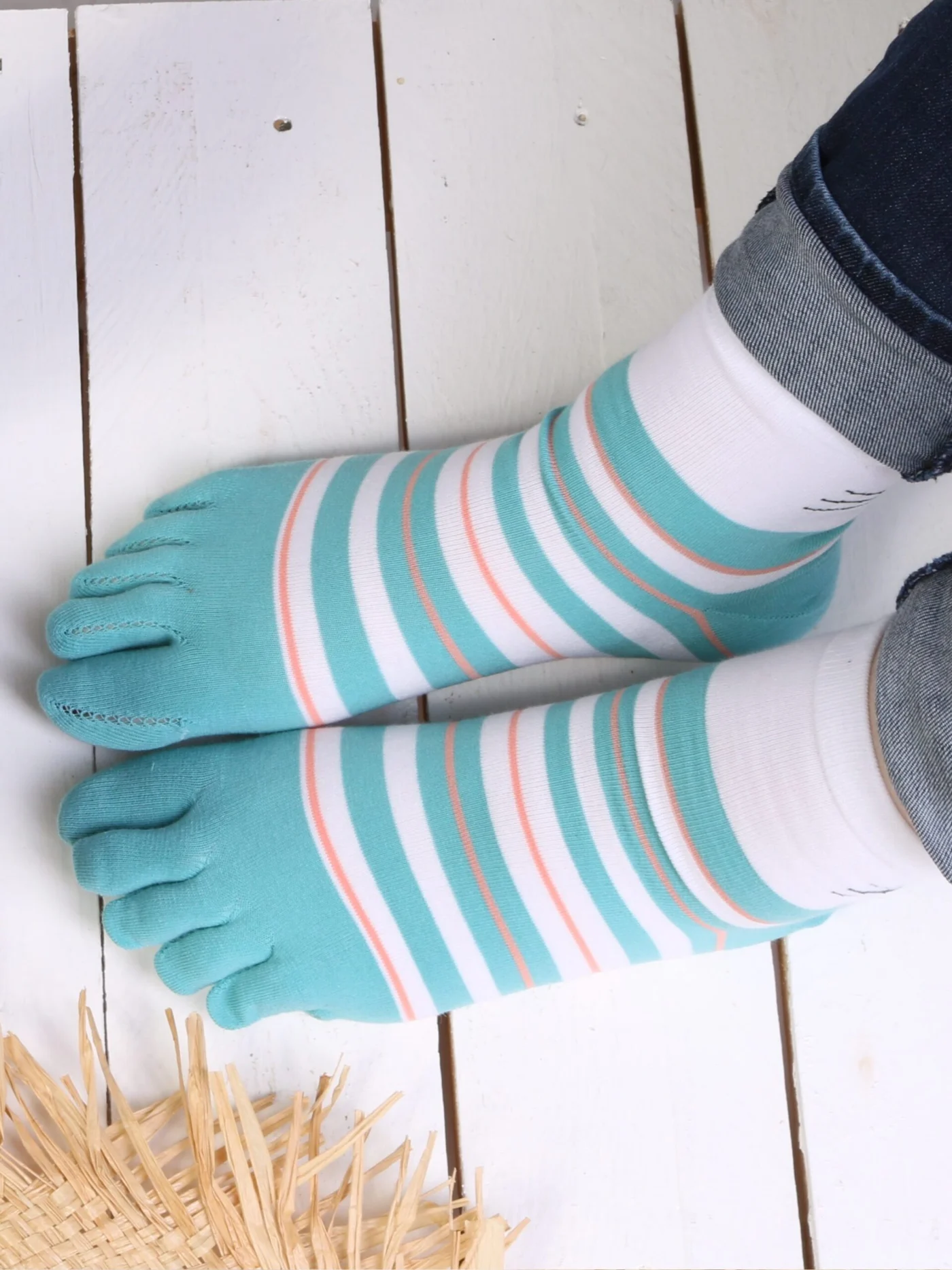
    To avoid tearing, turn the tights inside out before washing! This way, your children’s tights will last a lot longer.

    What to do with tights that have become too small?

    Since children grow at a crazy speed, the clothes and tights bought at the beginning of the school year often no longer fit at the end of the school year. 

    Not to mention those pairs of tights that ‘accidentally’ have gotten a hole in one leg. 

    Fortunately, we have some great ideas for what to do with tights that are too small (and also have holes), so they don’t have to find their way to the trash bin.

    floral tights

    A cute octopus from old hosiery

    You will need:

    • Four pairs of old pantyhose
    • Filling material, such as cotton batting
    • Some thread
    • Toy eyes, for example, from some other shirt or clothing that has become too small to wear 

    Do this:

    1. Stuff all of the octopus’s legs (aka the tights) with cotton batting (or some other filling material) up to about the knee; no more is needed.
    2. The trick with the octopus is that all the legs face the same direction.
    3. You can make a head for an octopus by twisting the upper part of a pair of pantyhose over the so-called legs (similarly to the way you twist a pair of socks to put them in a drawer). But so that the ‘head’ part does not remain upside down, cut a small hole between the leg parts and insert the leg part through there before turning. That’s how the head of the octopus is also the right way!
    4. Stuff the remaining three pairs of tights inside the octopus head, so the legs are at the same height on all legs. Add a little stuffing inside the head to make a round ball.
    5. Sew the hole you made before and also the head of the octopus with thread so that it stays nicely on the legs
    6. Sew on the eyes
    7. And that’s it! Meet your new octopus friend! 
  • DIY Sock Crafts: Old Socks Recycled in a Fun and Simple Way

    DIY Sock Crafts: Old Socks Recycled in a Fun and Simple Way

    Got a pile of old, unmatched socks gathering dust in your drawer? Instead of throwing them away, why not transform them into something unique and creative? This article explores five fun DIY Sock Crafts that can breathe new life into your old socks, turning them into delightful new treasures. From decorative flowerpot covers to playful toy fish, these projects are not only easy and enjoyable but also environmentally friendly by repurposing materials you already have.

    1. Flowerpot Covers
    2. Toy Fish
    3. Sock Puppet
    4. Stuffed Animal
    5. iPhone Armband
    6. Conclusion
    7. Frequently Asked Questions
  • Key Takeaways

    Flowerpot Covers

    Transform your old, colorful socks into charming flowerpot covers to add a splash of personality to your indoor plants. This simple DIY project not only recycles unused socks but also enhances the aesthetic of your living space without the need for expensive decorations.

    DIY Sock Crafts: flowerpot cover

    Steps to Create Flowerpot Covers:

    1. Choose socks with vibrant patterns or colors for maximum impact.
    2. Cut the foot part off if the sock is too long for your pot.
    3. Slip the sock over the flowerpot, adjusting it to fit snugly.
    4. Tuck in any excess material under the pot or fold it neatly at the rim.

    This DIY is perfect for those who want to personalize their space with minimal effort and cost.

    Remember, the type of sock you choose can turn a plain flowerpot into a delightful decor piece. Experiment with different textures and patterns to see what works best with your home’s overall theme.

    Toy Fish

    Transform your old socks into delightful toy fish that can provide hours of entertainment and creativity for children. This simple DIY project is not only fun but also a great way to repurpose materials you already have at home.

    Steps to Create Toy Fish

    1. Select colorful old socks to make the fish vibrant and appealing.
    2. Cut the socks into the shape of a fish body.
    3. Use buttons or beads for the eyes and felt pieces for fins.
    4. Stuff the sock with cotton or fabric scraps to give it volume.
    5. Sew the edges together, ensuring the stuffing stays inside.
    6. Optionally, attach a string at the front if you want the toy fish to be used as a pull toy.

    Encourage your child to create, innovate, and learn through the joy of repurposing!

    DIY Sock Crafts: toy fish

    This project not only stimulates creativity but also teaches children about recycling and the importance of giving new life to old items. It’s a perfect weekend activity that can be enjoyed by the whole family.

    YOU WILL FIND THE MOST ECO-FRIENDLY TIGHTS AND SOCKS ON OUR WEBSITE

    Sock Puppet

    Transform your old, colorful socks into a delightful Rat Sock Puppet with this simple DIY project. Perfect for a fun craft activity, sock puppets can bring a touch of whimsy and a lot of personality to playtime. Here’s how you can create your own:

    DIY Sock Crafts: rat sock puppet
    1. Choose a Sock: Select a colorful or patterned sock to serve as the body of your puppet.
    2. Gather Materials: You will need buttons for eyes, yarn for hair, and fabric scraps for additional features.
    3. Assemble: Attach the eyes and hair to the sock using hot glue or thread. Use fabric scraps to make ears, a nose, and a mouth.
    4. Personalize: Add unique touches by drawing or sewing on additional details to give your puppet character.

    Encourage creativity and storytelling by involving children in the puppet-making process, allowing them to choose the features and accessories for their puppet.

    Stuffed Animal

    Transform your old, mismatched socks into delightful stuffed animals. Whether it’s a classic sock monkey, a cuddly bear, or any creature your imagination conjures up, this project is perfect for both beginners and seasoned crafters.

    Steps to Create a Stuffed Animal

    1. Select your socks: Choose socks with fun patterns or colors for more visually appealing toys.
    2. Cut and sew: Cut the socks according to the animal shape you desire, then sew them together, leaving a space for stuffing.
    3. Add stuffing: Use homemade stuffing or standard polyester filling to give your creation volume and softness.
    4. Final touches: Sew on buttons for eyes or embroider facial features to bring your stuffed animal to life.
    DIY Sock Crafts: stuffed animal

    This DIY project not only recycles old socks but also provides a wonderful opportunity to craft unique, personalized gifts or toys.

    iPhone Armband

    Transform an old sock into a comfortable iPhone armband for your running sessions. This DIY project is not only cost-effective but also allows you to customize the armband to your style preferences. Here’s how you can create your own:

    DIY Sock Crafts: iPhone Armband
    1. Choose a sock that fits snugly around your arm.
    2. Cut off the toe section of the sock.
    3. Slide your iPhone into the sock from the cut end, ensuring the screen is visible through the fabric.
    4. Use the other part of the sock to secure the device by wrapping it around your arm and tucking in the end.

    This DIY iPhone armband is the perfect way to take an old sock on a run with you!

    Conclusion

    As we’ve explored various fun and creative DIY projects to transform old socks into new treasures, it’s clear that the possibilities are truly endless. From cozy flowerpot covers to playful toy fish, these projects not only provide a unique way to repurpose old socks but also offer an opportunity to engage in sustainable practices. So, gather up those neglected socks and let your creativity take the lead. You’ll be amazed at what you can create, and how even the simplest items can be turned into something wonderful and new. Embrace the joy of DIY and turn your old socks into delightful treasures that bring a touch of handmade charm to your life.

    SHORT ON SOCKS? NO WORRIES, WE HAVE YOU COVERED! SHOP NOW!

    Frequently Asked Questions

    Can I use any type of sock for these DIY projects?

    Yes, you can use any type of sock for these projects, whether they are cotton, wool, or synthetic blends. Just make sure they are clean and dry before starting.

    Do I need any special tools for these crafts?

    Basic crafting tools like scissors, glue, and a sewing kit are sufficient for most of these projects. Additional materials like buttons or fabric scraps may be needed depending on the project.

    Are these projects suitable for children?

    Yes, projects like sock puppets and toy fish are great for children. However, supervision is recommended, especially when using scissors or other sharp tools.

    How long do these projects typically take?

    Most projects can be completed in an afternoon. Projects that involve sewing or more detailed customization may take longer.

    Can these DIY projects be washed?

    Yes, most of the crafted items can be gently washed by hand. However, it’s advisable to avoid machine washing to prevent damage.

    Is there a way to make these crafts eco-friendlier?

    Yes, using eco-friendly materials like biodegradable stuffing and natural dyes can make these projects more environmentally friendly. Additionally, repurposing old socks itself is a great step towards sustainability.

    Join our newsletter Be the first to know about new products and offers.